What is the Bolar exemption?
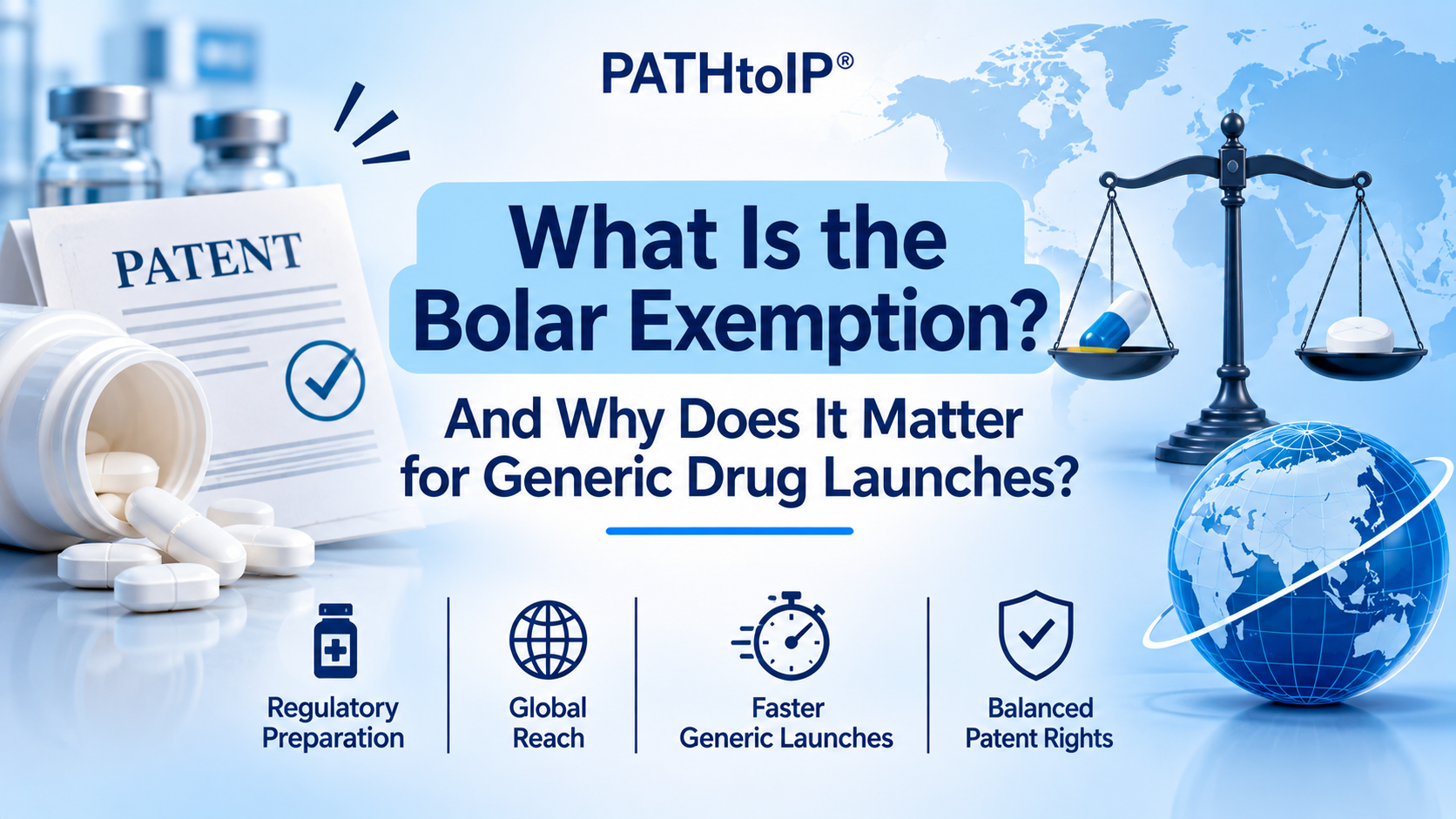
The Bolar exemption, sometimes called the Bolar provision, is an exception to patent infringement. It allows the use of a patented product or process for activities that are reasonably related to getting regulatory approval, such as producing the test data a drug regulator asks for. It is a limit on what a patent holder can stop, not a type of patent.
A patent normally gives its owner the exclusive right to make, use, sell or import the invention. Without the exemption, a competitor could not even make test batches of a patented medicine until the patent had run out. With it, the competitor can do the preparatory work during the patent term, as long as the work stays on the regulatory side of the line and does not turn into commercial selling.
Bolar exemption in plain words
- It applies to preparation, not to marketing.
- It is tied to a purpose: developing and submitting information that the law requires for regulatory approval.
- It is most often used by generic and biosimilar developers, but the idea is about the purpose of the activity, not about who is doing it.
Why does the Bolar exemption exist?
It exists to stop a patent from lasting longer in practice than it does on paper. A medicine cannot be sold until a regulator has approved it, and approval needs data from testing, such as studies showing that a generic version behaves like the original. If a generic company could only start that work once the patent had expired, the patent holder would keep the market to itself for the months or years the approval takes.
The exemption closes that gap. It lets the generic company do the groundwork during the patent term so that it can be ready to launch when the patent ends. The patent holder keeps full protection against actual sales for the whole term.
Where does the name come from?
The name comes from a 1984 US court case, Roche Products, Inc. v. Bolar Pharmaceutical Co. The court’s decision left generic makers without a safe way to do approval-related testing, and the US Congress responded with a statutory exception shortly afterwards. The idea has since been adopted in many countries, including India, and it kept the name of the case that started it. The case is covered in detail below.
How does the Bolar exemption work?
The test is one of purpose. An activity is protected when it is done to develop and submit the information a regulator requires, and not when it is done to build a market position. In general terms, the line falls as follows.
What the exemption typically covers?
- Making or using the patented product to develop the generic or follow-on version
- Running the studies and tests regulators ask for as part of an approval filing
- Gathering data for approvals in India or in other countries, where the local law allows it
What it does not cover?
- Selling the product commercially while the patent is still in force
- Using approval work as cover for an early launch or for building stock to sell
- Any activity that is not genuinely tied to regulatory approval
The last point matters most. Because the exemption turns on purpose, the facts of each case decide whether an activity falls inside it, and patent holders and generic makers do sometimes disagree about where the line sits.
A simple timeline
- The patent is granted and runs for its term.
- Near the end of the term, a generic maker starts the testing and filings needed for regulatory approval, protected by the Bolar exemption.
- The patent expires.
- The generic maker, already approved or close to it, can launch promptly.
How does the Bolar exemption work in India?
India’s Bolar provision is Section 107A of the Patents Act, 1970. Under Section 107A(a), making, constructing, using, selling or importing a patented invention is not infringement when it is done solely for uses reasonably related to developing and submitting the information that a law requires, in India or in a country other than India, to regulate the manufacture, use, sale or import of a product.
The provision was inserted by the Patents (Amendment) Act, 2002, with effect from 20 May 2003, and was widened in 2005 to cover importing as well as using and selling. Clause (b) deals with a related situation: importing a patented product from a person who is duly authorized under the law to produce and sell or distribute it.
What the Delhi High Court has said about exports?
The wording “in a country other than India” raised a practical question: can a company in India make a patented product and ship it abroad to support a foreign approval? In Bayer v. Natco and Bayer v. Alembic, a 2019 Division Bench ruling, the Delhi High Court held that exporting a patented invention for research or regulatory purposes falls within “selling” in Section 107A(a), so it is not infringement.
The court did not set a fixed quantity limit. It said each case depends on its facts and applied a “reasonable relation” test, listing factors such as the product, the quantity, the end use and the foreign regulations involved. That keeps the exemption tied to its purpose, rather than to a number.
Real-life example: Roche v. Bolar (1984)
The case that gave the exemption its name is Roche Products, Inc. v. Bolar Pharmaceutical Co., 733 F.2d 858, decided by the US Court of Appeals for the Federal Circuit on 23 April 1984.
What happened?
Roche sold Dalmane, a sleep aid whose active ingredient, flurazepam, was protected by a patent. Bolar, a generic manufacturer, wanted to launch its own version as soon as the patent expired. Before expiry, it used the patented chemical in experiments to show that its generic was bioequivalent to Dalmane, so that it could apply for approval from the US Food and Drug Administration (FDA).
What the court decided?
Bolar argued that its work fell within the experimental use exception, which allows some research on a patented invention. The court disagreed. It found that Bolar intended to sell its generic in competition with Dalmane after the patent expired, which gave the experiments a business purpose. Bolar also argued that the public benefits from generics reaching the market immediately after expiry. The court answered that this kind of policy decision should be made by Congress.
What Congress did?
Congress acted soon after. It created a statutory exception allowing the use of patented products in experiments needed to obtain FDA approval. That exception sits within the Drug Price Competition and Patent Term Restoration Act of 1984, known as the Hatch-Waxman Act, which established the modern approval pathway for generic drugs in the United States.
Why this case still matters?
- It shows why the exemption exists: without it, even testing for approval can count as infringement.
- It separates the two ideas people often mix up. The court rejected the general experimental use defense, and the legislature then added a narrower, purpose-based exception for regulatory work.
- It explains the name. Today, similar provisions in many countries, including India’s Section 107A, are called Bolar provisions after this case.
Common misconceptions about the Bolar exemption
| Misconception | The reality |
| The Bolar exemption is a type of patent. | It is not a patent. It is a limit on patent rights: certain regulatory activities are not treated as infringement. |
| It lets generics sell during the patent term. | It covers development and approval work only. Commercial sale during the patent term is still infringement. |
| It is the same as the experimental use exception. | They are different. Experimental use is a broader research idea. The Bolar exemption is tied to regulatory approval, and it was created because courts, as in Roche v. Bolar, did not treat approval testing as protected experimental use. |
| It only applies to testing done inside the country. | India’s Section 107A refers to information required under laws in India or in another country, and the Delhi High Court has held that exports for such purposes can fall within it, judged case by case. |
| A small quantity is always safe and a large one is never allowed. | There is no fixed volume rule. The Delhi High Court’s reasonable relation test looks at the product, the quantity, the end use and the regulations involved. |
| It is only for generic companies. | The Indian wording is about the purpose of the activity, not the type of company. In practice, generic and biosimilar developers use it most. |
Why does the Bolar exemption matter for generic makers and innovators?
Timing is the reason. In the United States, generics and biosimilars filled 90% of prescriptions in 2024 but accounted for 12% of drug spending, and generated $467 billion in savings that year, according to the Association for Accessible Medicines. The sooner a generic can launch after a patent ends, the sooner those benefits reach patients. These are US figures, but the principle applies anywhere approval takes time.
For generic and biosimilar developers
- It makes a launch plan possible. Approval work can run alongside the final years of the patent term.
- It rewards early planning. Knowing which activities are protected, and keeping clear records of their regulatory purpose, helps avoid disputes.
- It calls for care at the edges, especially with exports, quantities and anything that looks like stock for sale.
For innovators and patent holders
- It defines the real boundary of a patent. Protection against sales stays intact, but preparation for approval is not something the patent can stop.
- It is worth factoring into lifecycle planning. Expiry dates, and what competitors can do before them, shape the commercial picture.
- It is not a reason to stop enforcing. Activity that goes beyond regulatory purposes can still be infringement.
How PATHtoIP can help
Whether you are preparing a generic or biosimilar launch or protecting an innovative product, questions about patent expiry and permitted activity are easier to answer early. PATHtoIP works with pharma, biotech and chemical companies on:
- Freedom-to-operate analysis, to understand which patents could affect your product and when they expire
- Patent landscape and white space analysis, to see where protection is crowded and where there is room to move
- Patent strategy and drafting, so that innovators build protection that holds up across the product lifecycle
Every product and timeline is different, and how the Bolar exemption applies depends on the facts. If you would like to talk it through, reach out to us at info@pathtoip.com and our team will be happy to help.
Sources
- Section 107A, Patents Act, 1970 (Courtbook): text and amendment history
- Delhi HC Division Bench on export under India’s Bolar exception (SpicyIP, June 2019): Bayer v. Natco and Bayer v. Alembic
- Roche Products, Inc. v. Bolar Pharmaceutical Co. (Wikipedia): facts and outcome of the 1984 case
- Generic and Biosimilar Medicines Save $467 Billion in 2024 (Association for Accessible Medicines): US prescription, spending and savings figures
This article is for general information and is not legal advice.
Stay connected with PATHtoIP for the latest insights on patents, trademarks, copyrights, innovation, and IP strategy. Follow us on LinkedIn, Instagram, Facebook, X , Pinterest, YouTube, and Quora for expert guidance, industry updates, case studies, and practical tips to protect your innovations.
Frequently Asked Questions
What is the Bolar exemption in simple words?
It is a rule that lets a company use a patented product before the patent expires, but only to create the data needed for regulatory approval. It does not allow selling the product while the patent is in force.
Why is it called the Bolar exemption?
It is named after the 1984 US case Roche Products, Inc. v. Bolar Pharmaceutical Co., in which a generic manufacturer’s pre-expiry testing was held to infringe a patent. The US Congress then created a statutory exception, and similar provisions in other countries took the same name.
Is there a Bolar exemption in India?
Yes. It is found in Section 107A of the Patents Act, 1970. It covers acts done solely for uses reasonably related to developing and submitting information required under laws in India or in another country.