Introduction
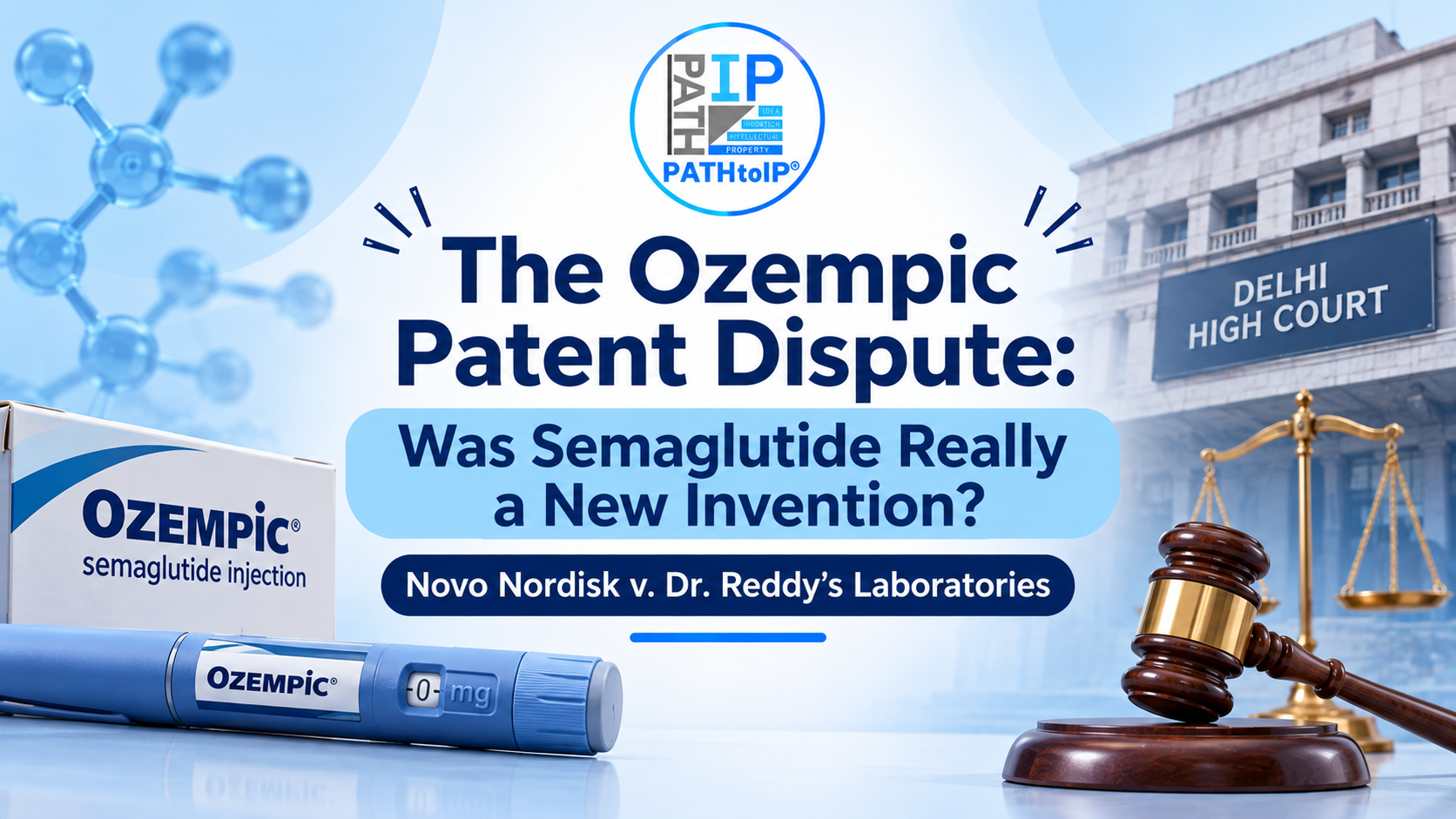
The Ozempic Patent Dispute began in India, where a fight over who could make semaglutide, the active ingredient behind Ozempic, Wegovy and Rybelsus, ended up in the Delhi High Court. At stake was whether Novo Nordisk’s patent should have been granted at all. The question at the center was simple to say and hard to answer: was semaglutide a genuinely new invention, or a small step from something Novo Nordisk had already patented?
Plaintiff: Novo Nordisk A/S
Defendants: Dr. Reddy’s Laboratories Ltd. and OneSource Specialty Pharma Ltd.
What Is the Novo Nordisk v. Dr. Reddy’s Case About?
What Was the Dispute Over?
Novo Nordisk held Indian Patent No. 262697 (the “suit patent”, also called IN’697), titled “Acylated GLP-1 Analogs Comprising Non-Proteogenic Amino Acid Residue”. It covers semaglutide and was due to expire on 20 March 2026. Novo Nordisk said Dr. Reddy’s was making and exporting semaglutide in India without permission and sued for patent infringement.
Who Are the Parties and What Did Each Side Argue?
Novo Nordisk argued that semaglutide was novel and inventive, and that its earlier patent never specifically disclosed or claimed the compound. Dr. Reddy’s argued the opposite: that semaglutide was already disclosed and claimed in an earlier Novo Nordisk patent, so the suit patent was invalid and an attempt at evergreening.
What Is the Background of the Semaglutide Patent Dispute?
How Did the Case Begin?
Novo Nordisk says it learned in December 2024 that Dr. Reddy’s was importing and exporting semaglutide. According to reports, Dr. Reddy’s began manufacturing in India around April 2025. A cease-and-desist notice followed on 5 May 2025, and Novo Nordisk then filed its suit in the Delhi High Court. On 29 May 2025, Dr. Reddy’s gave an undertaking that it would not sell semaglutide in India and would limit itself to exports to countries where Novo Nordisk had no patent.
What Is the Difference Between a Genus Patent and a Species Patent?
A genus patent covers a broad family of related compounds. A specific patent covers one specific compound within that family. Novo Nordisk had an earlier genus patent, IN’964, published in March 2005. The suit patent, IN ‘697, was the specific patent claiming semaglutide itself. Dr. Reddy’s case was that the genus patent already pointed to semaglutide, so the second patent added nothing new.
Why Did the Priority Date Matter So Much?
A patent can only be attacked using prior art that came before its priority date. Novo Nordisk claimed a priority date of March 2005 for the suit patent, which would mean the genus patent (published 31 March 2005) was not prior art against it. Dr. Reddy’s relied on a European Opposition Division finding that moved the effective priority date to 20 March 2006. The Court accepted this for the interim stage, which made the genus patent valid prior art.
What Did the Delhi High Court Decide?
What Did the Single Judge Rule on 2 December 2025?
Justice Manmeet Pritam Singh Arora refused Novo Nordisk’s request for an interim injunction (Novo Nordisk A/S v. Dr. Reddy’s Laboratories Ltd., CS(COMM) 565/2025, 2025: DHC:10820). The Court held that Dr. Reddy’s had raised a credible challenge to the suit patent under Section 64(1)(a), (e) and (f) of the Patents Act, 1970, covering prior claiming, anticipation by prior publication, and obviousness.
Why Did the Court Think Semaglutide Might Be Obvious?
The Court looked at an example compound in the genus patent (Example 61) and compared it with semaglutide. The difference came down to a single amino acid substitution, and the genus patent itself pointed a skilled person towards that change. The Court also noted that the same inventors were behind both patents, so it assessed obviousness from the viewpoint of a “person in the know”. It also took note that Novo Nordisk’s own regulatory and patent filings had linked semaglutide to the genus patent.
What Was Dr. Reddy’s Allowed and Not Allowed to Do?
Dr. Reddy’s could continue to manufacture semaglutide and export it to countries where Novo Nordisk holds no patent. It could not sell in India until the suit patent expired, and it had to keep accounts of what it made and exported. The Court also weighed the balance of convenience: Novo Nordisk imports its product into India rather than manufacturing here, and the patent had only a few months left to run. The Court did not release Dr. Reddy’s from its undertaking, because it had started manufacturing without first clearing the way by challenging the patent.
What Did the Division Bench Say on 9 March 2026?
Novo Nordisk appealed (FAO(OS)(COMM) 204/2025), but the Division Bench dismissed the appeal on 9 March 2026. It applied the settled, narrow standard for interfering with interim orders. It differed from the Single Judge on one point: it did not agree that prior claiming under Section 64(1)(a) was made out. It found the credible challenge instead of anticipation by prior publication (Section 64(1)(e)) and obviousness (Section 64(1)(f)). Notably, it observed that two of the three features Novo Nordisk relied on to distinguish semaglutide were already present in the genus patent’s example compound.
Why Does This Case Matter for Pharma IP?
Does It Mean the Semaglutide Patent Was Declared Invalid?
No. These were interim orders, and the findings were prima facie, meaning a first impression on the material available. The patent was not formally revoked. What the courts decided was that Dr. Reddy’s challenge was strong enough to deny an injunction.
What Does It Say About Evergreening and Follow-On Patents?
Dr. Reddy’s argued that Novo Nordisk’s later patent was a case of evergreening, where a new patent on a specific compound is used to extend exclusivity beyond the original patent. The case shows that such a follow-on patent can be vulnerable if an earlier patent by the same owner already points to it. Patent owners cannot assume that a species patent will stand just because the specific compound was never named in the genus patent. The decision is also a reminder to be consistent: what a company says in other filings can be used against it in court.
What Happened After the Patent Expired?
The Indian semaglutide patent expired on 20 March 2026, and reports say more than 15 Indian drugmakers launched generic versions within about 48 hours. A trademark dispute followed: Novo Nordisk objected to Dr. Reddy’s brand name OLYMVIQ as being similar to OZEMPIC, and Dr. Reddy’s agreed to stop using it and move to a new name.
What Are the Key Takeaways from the Ozempic Patent Dispute?
- Patent owners: Draft genus and species claim together as a strategy. A species patent filed later can be attacked using your own earlier genus patent.
- Generic manufacturers: A well-prepared validity challenge, backed by prior art and priority-date evidence, can defeat an interim injunction even against a blockbuster drug. Clearing the way before manufacturing is still safer.
- Courts: Indian courts will look at the substance of a follow-on patent, not just its form, and will weigh public interest and the time left on the patent.
- Startups and innovators: Check what you have already published or filed before seeking a new patent on an improvement.
Conclusion: Was Semaglutide Really a New Invention?
The Delhi High Court did not give a final answer, but its reasoning leans one way. The step from Novo Nordisk’s earlier genus patent to semaglutide looked small and was pointed to by the earlier patent itself. For anyone working with pharmaceutical patents, the case is a clear lesson in how genus and species patents, priority dates and prior filings interact. If you are planning a patent strategy or need to assess the strength of an existing patent, the team at PATHtoIP can help.
References
- Novo Nordisk A/S v. Dr. Reddy’s Laboratories Ltd. & Anr., CS(COMM) 565/2025, Delhi High Court, 2 December 2025 (2025: DHC:10820)
- Novo Nordisk A/S v. Dr. Reddy’s Laboratories Ltd. & Anr., FAO(OS)(COMM) 204/2025, Delhi High Court (Division Bench), 9 March 2026 (2026: DHC:1911-DB)
- Bar & Bench, Verdictum, LiveLaw and BananaIP case reports on the 2 December 2025 and 9 March 2026 orders
- Legal500 and Mondaq (Remfry & Sagar), “India’s Ozempic Moment”
Stay connected with PATHtoIP for the latest insights on patents, trademarks, copyrights, innovation, and IP strategy. Follow us on LinkedIn, Instagram, Facebook, X , Pinterest, YouTube, and Quora for expert guidance, industry updates, case studies, and practical tips to protect your innovations.
Frequently Asked Questions
Is Semaglutide the Same as Ozempic?
Semaglutide is the active ingredient, and Ozempic is one of the brand names Novo Nordisk sells it under. The same compound is also used in Wegovy and Rybelsus. The case was about the compound itself, not any one brand.
Did the Delhi High Court Cancel Novo Nordisk's Semaglutide Patent?
No. The court only refused an interim injunction after finding that Dr. Reddy’s had a credible challenge to the patent’s validity. A full trial on validity was never the subject of these orders, so the patent was not formally revoked.
What Is Evergreening in Patent Law?
Evergreening is the practice of obtaining new patents on small changes to an existing product so that the owner’s exclusivity lasts longer than the original patent would allow. Dr. Reddy’s argued that the semaglutide species patent was this kind of attempt, and the court found its challenge credible at the interim stage.
Can Indian Companies Sell Generic Semaglutide Now?
Yes. Novo Nordisk’s Indian semaglutide patent expired on 20 March 2026, and several Indian drugmakers launched generic versions soon after. Generic makers still have to avoid brand names that are confusingly similar to registered trademarks, as the OLYMVIQ and OZEMPIC dispute showed.