What is patent evergreening in IP ?
If you’ve read about patent thickets, you’ve already brushed up against evergreening, the two terms travel together constantly. But they’re not quite the same thing, and the distinction matters if you’re building or challenging a pharma patent portfolio. A thicket describes the density of overlapping patents around a product. Evergreening describes the strategy: deliberately sequencing new patent filings to extend commercial exclusivity well past the point the original patent would have allowed.
Defining Evergreening
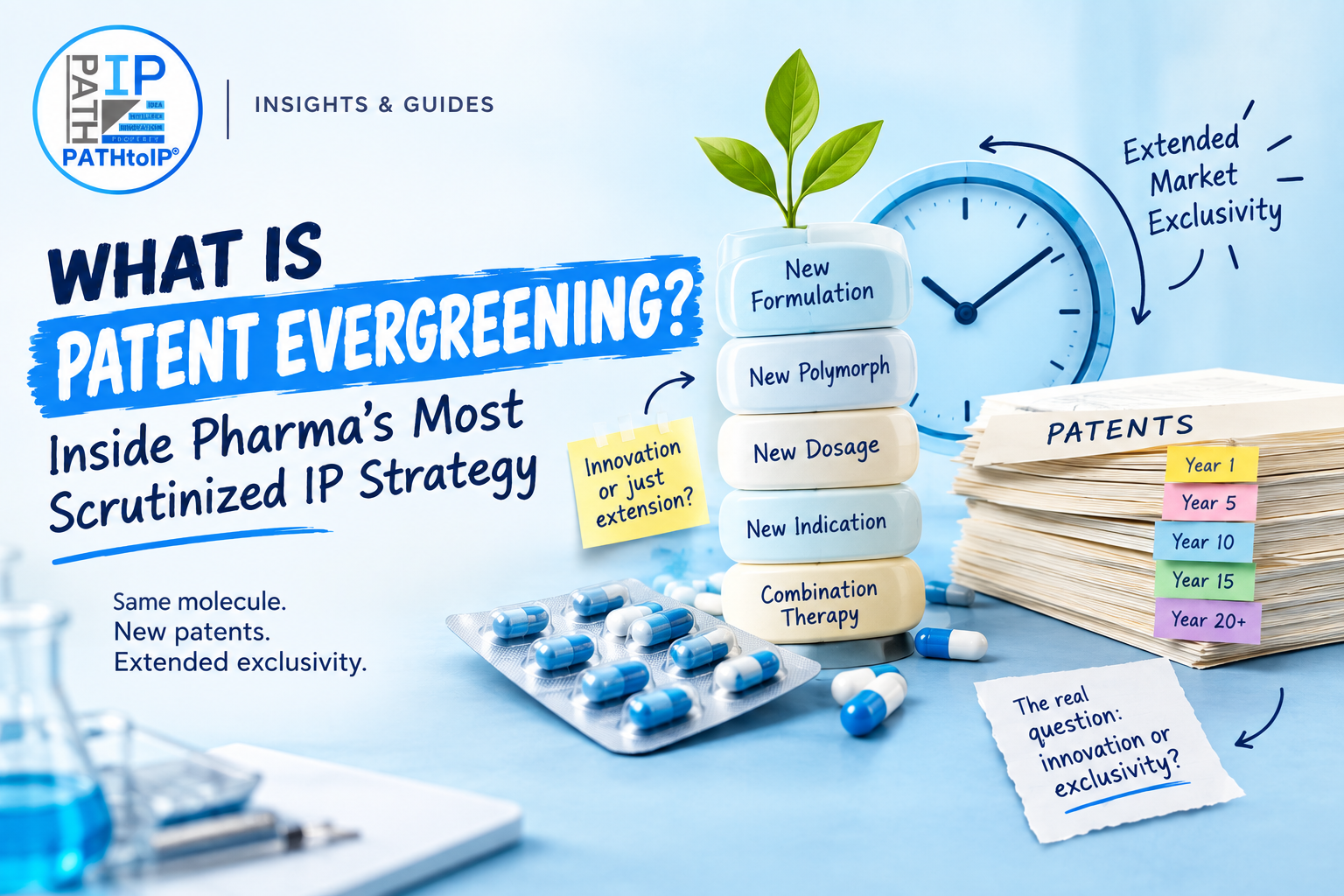
Patent evergreening refers to the practice of filing successive, incremental patents on an existing product, new formulations, delivery methods, dosing regimens, or combinations, timed so that as one patent nears expiry, another has already been secured to maintain market exclusivity. The name captures the idea: the “greenery” of patent protection never fully dies back, because a new layer grows in before the old one withers.
Unlike a thicket, evergreening doesn’t necessarily require dozens of patents. Even a single, well-timed follow-on patent, say, switching a formulation just before generic entry, can function as an evergreening strategy if its primary commercial purpose is to reset the exclusivity clock rather than deliver a meaningful therapeutic advance.
Common Evergreening Techniques
Pharmaceutical evergreening tends to follow a recognizable playbook:
- New crystalline forms or polymorphs: patenting a different physical structure of the same active molecule
- Enantiomer patents: isolating and patenting a single active enantiomer of a molecule originally marketed as a racemic mixture
- Reformulation (“product hopping”): shifting the market to a new formulation (e.g., extended release) shortly before the original version faces generic competition
- Combination products: pairing an off-patent active ingredient with another compound to create a new patentable combination
- New method-of-use patents: covering a newly discovered indication, patient population, or treatment regimen for an existing drug
- Pediatric and orphan drug extensions: leveraging regulatory exclusivity extensions tied to additional trials, sometimes timed for exclusivity benefit as much as clinical need
None of these are inherently improper. Genuine therapeutic improvements, a safer enantiomer, a better-tolerated formulation, are legitimately patentable. The legal and ethical scrutiny centers on intent and effect: is the filing driven by real innovation, or by exclusivity timing?
Case Study 1: Novartis and Glivec (India)
The most cited evergreening case globally is Novartis AG v. Union of India (2013). Novartis sought an Indian patent on the beta crystalline form of imatinib mesylate, marketed as Glivec, a leukemia drug, after the base compound patent had already been filed elsewhere. India’s Patents Act includes Section 3(d), a provision specifically designed to prevent evergreening: it bars patents on new forms of a known substance unless the applicant can show a significant increase in therapeutic efficacy, not merely a change in form.
The Indian Supreme Court rejected the patent, ruling that Novartis had not demonstrated the beta crystalline form was significantly more efficacious than the known substance. The case became a global reference point for how a jurisdiction can build evergreening resistance directly into patentability standards, rather than relying solely on post-grant litigation.
This points to an important jurisdictional contrast: in India, Section 3(d) makes most evergreening-style secondary patents unpatentable outright, they simply cannot be granted absent demonstrated efficacy gains, which functionally shuts the strategy down at the application stage. In the United States, evergreening is not illegal or barred by statute, a secondary patent on a new formulation, polymorph, or method of use can be validly granted and enforced. It only becomes vulnerable if challenged on doctrines like obviousness-type double patenting, or if the surrounding conduct is found to violate antitrust law. The US relies on case-by-case scrutiny; India bakes the restriction directly into the patentability test.
Case Study 2: AstraZeneca’s Prilosec-to-Nexium Switch
A classic U.S. example of product hopping involved AstraZeneca’s ulcer and acid-reflux drug Prilosec (omeprazole). As Prilosec’s patent protection neared its end, AstraZeneca secured patent protection on Nexium (esomeprazole), the purified single-enantiomer version of the same active compound and shifted marketing and sales efforts toward Nexium ahead of Prilosec’s generic entry.
The strategy didn’t rely on invalid patents; the Nexium patents were separately valid. The scrutiny instead focused on the commercial pattern: switching prescriber and patient behavior toward a newly patented product right as the older one opened to generic competition, a pattern regulators and courts have examined closely in multiple “product hopping” antitrust cases since.
The Regulatory and Legal Pushback
Evergreening sits under increasing legal pressure across multiple fronts:
- Section 3(d)-style efficacy requirements: India’s model has influenced discussion in other jurisdictions about requiring demonstrated efficacy gains for secondary pharmaceutical patents
- Obviousness-type double patenting (OTDP): a U.S. doctrine that can invalidate a later patent if it merely claims an obvious variation of an earlier, commonly owned patent, often paired with a terminal disclaimer requirement tying the later patent’s expiry to the earlier one
- Antitrust and competition law: the EU’s AstraZeneca v. Commission (2012) case found the company had abused a dominant market position through, among other conduct, patent and regulatory strategies aimed at delaying generic entry
- Inter partes review (IPR): and post-grant opposition proceedings, increasingly used by generic and biosimilar challengers to invalidate secondary patents before they can block market entry
Why the Debate Isn’t Going Away
Evergreening highlights a genuine tension in pharmaceutical IP policy. Secondary innovation can produce real clinical value, better tolerability, improved dosing convenience, safer profiles. But when the primary driver of a filing is exclusivity extension rather than patient benefit, it delays affordable access without a corresponding public benefit. Regulators, courts, and patent offices are still calibrating exactly where that line sits, which is precisely why understanding the term, and the doctrines built to police it, matters for anyone shaping pharma IP strategy today.
How PATHtoIP Helps
PATHtoIP advises pharmaceutical and biotech clients on building secondary patent portfolios that hold up to efficacy and obviousness scrutiny and on the flip side, on freedom-to-operate and patent-challenge strategy for companies looking to enter markets where evergreening patents may stand in the way. Our work spans jurisdictions with markedly different standards, from the U.S. and Europe to India’s Section 3(d) framework.
Stay connected with PATHtoIP for the latest insights on patents, trademarks, copyrights, innovation, and IP strategy. Follow us on LinkedIn, Instagram, Facebook, X , Pinterest, YouTube, and Quora for expert guidance, industry updates, case studies, and practical tips to protect your innovations.
Frequently Asked Questions
Is evergreening always illegal?
No. Filing new patents on genuine improvements is standard and lawful. Legal risk arises when the primary purpose of a filing is exclusivity extension without corresponding innovation, or when the broader conduct violates antitrust law.
How is evergreening different from a patent thicket?
Evergreening is a strategy, sequencing new filings to extend exclusivity. A patent thicket is often the result of that strategy, a dense cluster of overlapping patents. Not every thicket is built through evergreening, and not every evergreening strategy produces a full thicket.
Which jurisdictions have the strongest anti-evergreening rules?
India’s Section 3(d) is the most explicit example, requiring demonstrated efficacy gains for new forms of known substances, which effectively makes most evergreening-style patents unpatentable there. The U.S. has no equivalent statutory bar; evergreening patents can be granted and enforced and are instead tested case by case through doctrines like obviousness-type double patenting and antitrust enforcement.