Introduction
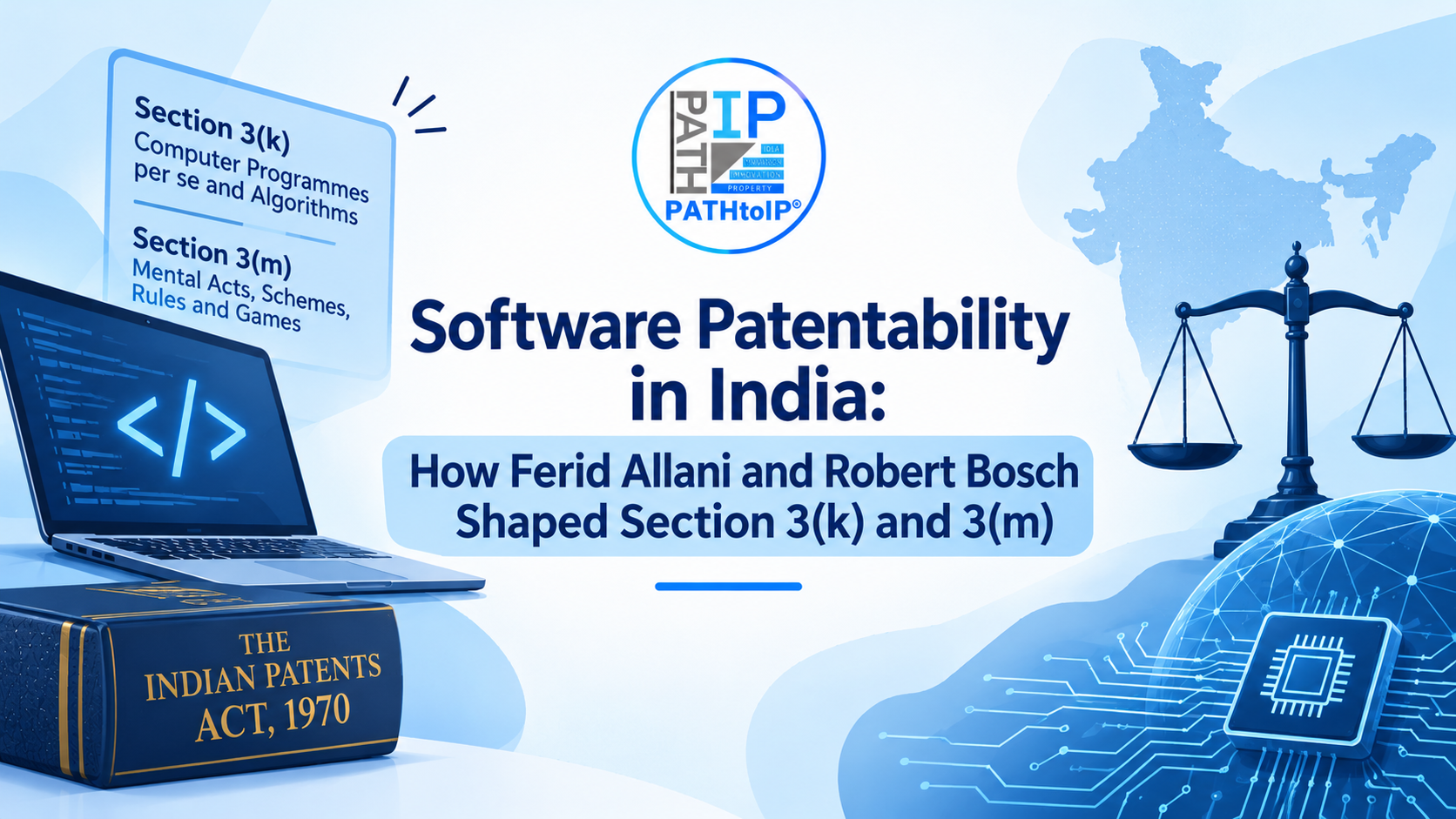
Software patentability in India has long been a grey area, but two landmark rulings, Ferid Allani v. Deputy Controller of Patents and Designs (2025) have made the rules much clearer for software and technology-driven inventions.
Can Software and Computer-Related Inventions Be Patented in India?
Technology is evolving rapidly through artificial intelligence, machine learning, cloud computing, cybersecurity and other digital innovations. As businesses rely more on software and technology-driven processes, knowing which parts of these innovations can be protected by patents has become increasingly important.
In India, patent eligibility is governed by the Indian Patents Act, 1970, particularly the exclusions in Section 3. But the courts have played a crucial role in explaining how those exclusions work in practice. This blog looks at the Ferid Allani and Robert Bosch Limited decisions and their impact on computer-related inventions (CRIs) and technical process claims.
What Do Section 3(k) and Section 3(m) of the Indian Patents Act Say?
Of the exclusions in Section 3, two are especially relevant to computer-related inventions.
Section 3(k): Computer Programmes Per Se and Algorithms
Section 3(k) says that a mathematical method, a business method, a computer programme per se or algorithms are not inventions, and so are not patentable.
Section 3(m): Mental Acts, Schemes, Rules and Games
Section 3(m) says that a mere scheme or rule or method of performing a mental act, or a method of playing a game, is not an invention.
Ferid Allani v. Union of India (2019): Is Every Software Invention Excluded Under Section 3(k)?
Case Snapshot
- Court: Delhi High Court
- Judgment date: 12 December 2019
- Bench: Justice Prathiba M. Singh
- Patent application no.: IN/PCT/2002/00705/DEL
- Petitioner: Ferid Allani
- Respondents: Union of India and the Controller of Patents
- Subject: Section 3(k) of the Indian Patents Act, 1970
The Invention
Ferid Allani’s invention was a method for navigating the web. It organised content into structured menus so that users did not have to keep searching with keywords. It combined locally stored navigation pages with dynamic retrieval of online information, giving direct access to websites and online services in a faster and easier way.
Legal Issues
- Was the claimed invention merely a computer programme per se, and so unpatentable under Section 3(k)?
- Can a computer-related invention (CRI) that provides a technical effect or technical contribution qualify for a patent even though it involves software?
Arguments of the Petitioner
The petitioner argued that the invention was not a computer programme but a CRI. It solved the technical problem of retrieving information efficiently on the web and had a technical effect and technical contribution. He said the Patent Office misapplied Section 3(k) simply because the invention involved software, and ignored the Computer Related Inventions (CRI) Guidelines, which recognise that software-based inventions with a technical contribution may be patentable. He also pointed out that such inventions are patentable before the European Patent Office (EPO) and in other jurisdictions.
Arguments of the Respondents
The respondents argued that the invention was nothing more than a computer programme per se, because it introduced no new hardware or technical feature apart from software. They added that the CRI Guidelines are only examination guidelines and cannot override the Patents Act, so the refusal under Section 3(k) was proper.
The Court’s Decision
The Delhi High Court held that Section 3(k) does not exclude every software-based invention. A computer programme per se is not patentable, but inventions that provide a technical effect or technical contribution must be considered on their merits. The Court set aside the rejection and directed the Patent Office to re-examine the application in line with these principles.
Robert Bosch Limited v. Deputy Controller of Patents and Designs (2025): Is a Method Claim Always Excluded Under Section 3(m)?
Case Snapshot
- Court: Madras High Court
- Judgment date: 25 March 2025
- Bench: Justice Senthilkumar Ramamoorthy
- Patent application no.: 201944047460
- Petitioner: Robert Bosch Limited
- Respondent: Deputy Controller of Patents and Designs
- Subject: Section 3(m) of the Indian Patents Act, 1970
The Invention
Robert Bosch Limited applied for a patent on a method of preheating and controlling the temperature of fuel injected into a combustion engine. The method used a fuel-heating device with sensors that feed an electronic control unit, which keeps the fuel at an optimal temperature before injection. The result is higher efficiency, lower emissions and better engine performance.
Legal Issues
- Was the claimed invention merely a method of performing a mental act, and so unpatentable under Section 3(m)?
- Can a technical method involving physical implementation qualify for a patent even though it is drafted as a method claim?
Arguments of the Petitioner
The petitioner argued that the invention was not a mental act or an abstract method. It was a technical process involving physical components, namely sensors, a fuel-heating device and an electronic control unit, with a technical effect seen in better fuel temperature control and engine performance. It said the Patent Office wrongly treated every method claim as unpatentable under Section 3(m), when the invention should be judged on its technical merits and not on how the claims were drafted.
Arguments of the Respondent
The respondent argued that the claims were only a method, an ordered series of steps that produced no patentable product and were therefore excluded by Section 3(m). On that basis, it said the application was rightly refused.
The Court’s Decision
The Madras High Court observed that Section 3(m) is meant to exclude mental acts, schemes or rules, and methods of playing games, not genuine technical processes. Because Bosch’s invention had physical components working together to produce a technical result, the application could not be rejected merely because it was drafted as a method claim. The Court set aside the rejection order and directed the Patent Office to consider the application again on the other patentability requirements, such as novelty and inventive step.
Key Takeaways for Inventors, Startups and Patent Practitioners
Software Inventions Are Not Automatically Unpatentable
After Ferid Allani, software-related inventions must be judged on their own merits, including any technical effect or technical contribution they offer.
Method Claims Should Not Be Rejected as a Blanket Rule
After Robert Bosch, each method claim has to be assessed on its own features under Section 3(m). A physical process that solves a technological problem is not excluded.
Draft Claims Around the Technical Problem, Solution and Practical Use
Clear language on the technical problem, the technical solution and the practical use of the invention is important when drafting and prosecuting applications in India.
Substance Over Form
The Indian Patent Office should look at the true technical contribution, not at whether the claims involve software or are worded as a method. That gives inventors, startups and practitioners more clarity.
Conclusion: Technical Contribution Decides Patent Eligibility
These judgments make clear that inventions should not be rejected merely because they involve software or are drafted as methods. What matters is the technical effect, technical contribution and practical application of the invention. As technology evolves, these landmark cases are likely to guide innovators, patent professionals and the Indian Patent Office as they balance promoting innovation with upholding the objectives of patent law.
Get Expert Help Protecting Your Software or Technology Invention
Planning to patent a software, AI or technology-driven invention in India, or facing a Section 3(k) or 3(m) objection? PATHtoIP can help with patentability assessment, patent drafting and responses to examination reports.
Get in touch with PATHtoIP today to discuss your invention.
Stay connected with PATHtoIP for the latest insights on patents, trademarks, copyrights, innovation, and IP strategy. Follow us on LinkedIn, Instagram, Facebook, X , Pinterest, YouTube, and Quora for expert guidance, industry updates, case studies, and practical tips to protect your innovations.
Frequently Asked Questions
What is a computer-related invention (CRI)?
A CRI is an invention that involves software or computing but solves a technical problem. The CRI Guidelines recognize that such inventions with a technical contribution may be patentable.
Can a method claim be patented in India?
Yes, if it is a genuine technical process. Section 3(m) excludes mental acts, schemes or rules and methods of playing games, but not technical processes, as the Madras High Court held in Robert Bosch.
What does a technical effect mean in patent law?
It is a real technical result produced by the invention, such as faster information retrieval on the web or better fuel temperature control in an engine.
How can applicants avoid Section 3(k) and 3(m) rejections?
By drafting claims around the technical problem, the technical solution and the practical use of the invention, so the technical contribution is clear.