Introduction
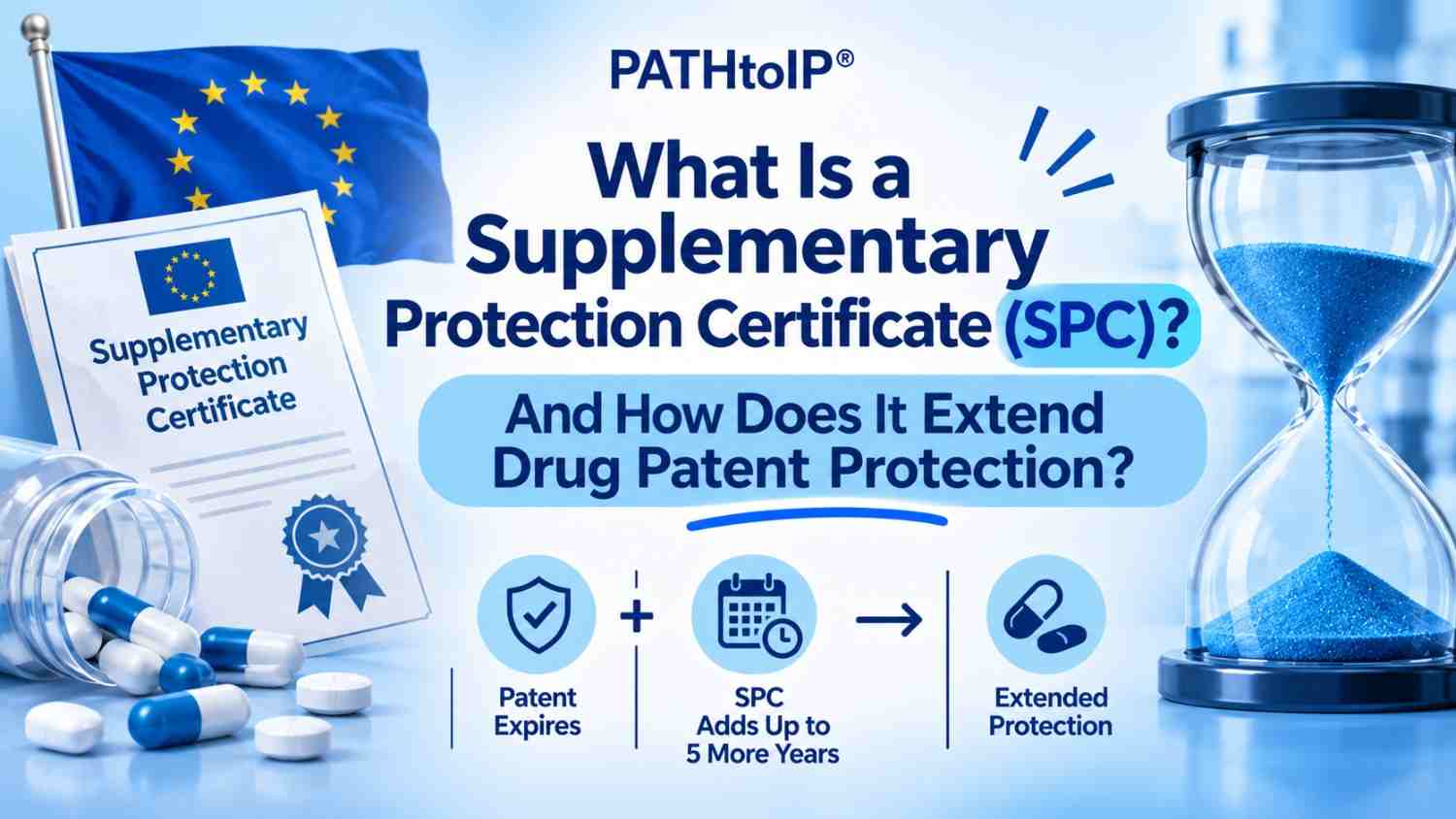
A Supplementary Protection Certificate (SPC) is an intellectual property right in Europe that extends protection for a medicine’s active ingredient for up to five years after its patent expires, to make up for the time lost waiting for regulatory approval. It protects the approved product, not the whole patent.
A drug patent starts its 20-year clock when it is filed, usually years before the medicine is tested, approved and sold. By launch day, much of that term may already be gone. SPCs were created to restore part of that lost time. India has no equivalent: Indian patents run for 20 years from filing with no extension. This article explains how SPCs work, how their length is calculated, what the unitary SPC reform means, and why a patent expiry date is not always the date a generic can launch. It also covers common misconceptions and answers frequent questions.
What is a Supplementary Protection Certificate?
An SPC is a separate intellectual property right, not an extra slice added to the patent itself. In the European Economic Area, it takes effect only after the underlying patent expires, and it covers regulated products such as human and veterinary medicines and plant protection products.
The key word is “product”. An SPC protects an active ingredient, or a combination of active ingredients, that is covered by a patent and approved for sale. Within those limits it gives the same rights as the patent, with the same limitations, but only for the authorised product and its authorised uses as a medicine. The rest of the patent’s subject matter is not extended.
The patent that supports the certificate is called the basic patent. SPCs for medicines were created by Regulation (EEC) No 1768/92, in force from 2 January 1993, and the rules are now found in Regulation (EC) No 469/2009.
SPC in plain words
- It is a certificate, granted on top of a patent, that keeps one approved product protected for longer.
- It protects the product, not the whole patent.
- It starts when the patent ends, and it has a maximum length.
Why do SPCs exist?
They exist because getting a medicine approved takes a long time, and the patent clock keeps running while it does. A company usually files its patent early, before clinical trials, and then spends years on testing and regulatory review. Only after approval can it sell the product and earn back its research costs. By then, the patent may have little time left.
SPCs compensate for that gap. They give the innovator some of the effective protection that the approval process uses up, so that the incentive to invest in long, costly drug development is not weakened.
How SPCs fit with the Bolar exemption?
SPCs and the Bolar exemption pull in different directions, and together they balance the system. The Bolar exemption lets generic makers prepare for approval during the patent term, so they can launch when protection ends. An SPC restores some of the time an innovator lost to approval, which moves the end of protection later. Knowing both is what lets a company work out when a generic can really enter a market.
How long does an SPC last?
An SPC lasts for the time between the patent’s filing date and the first marketing authorization in the European Economic Area, minus five years, and never for more than five years. Under Article 13 of the SPC Regulation, the certificate starts when the basic patent’s lawful term ends.
In other words, the formula gives the innovator back the time lost to approval, except for the first five years of it, and caps the result at five. The effect is that combined protection from the first approval normally cannot go beyond 15 years, according to Wikipedia’s summary of the regime.
Worked example (Illustrative dates)
Assume a patent is filed in 2010, so it expires in 2030 (20 years from filing).
| Case | First EU approval | Gap from filing | Gap minus 5 years | SPC length | Protection ends |
| A | 2018 | 8 years | 3 years | 3 years | 2033 (15 years after approval) |
| B | 2022 | 12 years | 7 years | 5 years (capped) | 2035 |
| C | 2014 | 4 years | None | No SPC | 2030 |
Pediatric extension
A further six months can be added where the applicant has completed an agreed Pediatric Investigation Plan, under Article 36 of Regulation 1901/2006. That makes the maximum 5.5 years of SPC, and 15.5 years of combined protection from first approval.
Is a short gap enough?
A certificate is only worthwhile when enough time passes between filing and approval. Following a 2011 CJEU decision, at least 4 years, 6 months and one day must pass between patent filing and the first EEA approval for an SPC to be available, as summarized by the same Wikipedia page.
What are the conditions for getting an SPC?
An SPC is not automatic. Four conditions must be met on the date the application is filed, as set out in Article 3 of the SPC Regulation:
- The product is protected by a basic patent that is in force.
- There is a valid authorization to place the product on the market as a medicine.
- The product has not already been the subject of a certificate.
- That authorization is the first one to place the product on the market as a medicinal product in the territory concerned.
The deadline
The application must be filed within six months of the marketing authorization being granted. If the authorization came before the patent was granted, the six months run from the grant of the patent (Article 7). A request for the pediatric extension can be made with the application, or later if it is made at least two years before the certificate expires.
The text above is taken from the UK version of the regulation, which is kept in the same form as the EU rules on these points. Missing the six-month window cannot usually be repaired, so the deadline should be in a company’s regulatory and IP calendar from the start.
How do SPCs work in Europe and the UK?
Today, SPCs are national rights. A company files in each country where it wants a certificate, and each national patent office examines and grants it separately. The UK continues to have its own SPC system under UK law, with separate rules for Great Britain and Northern Ireland authorizations.
What is unitary SPC reform?
The European Commission proposed a unitary SPC for medicines on 27 April 2023. It would complement the unitary patent, which entered into force on 1 June 2023. At present, national SPCs can follow a unitary patent, but there is no single certificate covering the same territory.
Under the proposal, a single centralized examination would lead to one unitary SPC for the member states where the patent has unitary effect, and national SPCs for the others. An applicant could file one combined application.
Where does it stand?
As of 25 October 2026, the European Parliament’s tracker shows that Parliament adopted its position on 28 February 2024, but the Council has not yet agreed a negotiating mandate, so negotiations between the institutions have not begun. Nothing has been adopted. Until it is, the national SPC system continues to apply.
It is a file worth watching, because a unitary certificate could change how companies plan filing, costs and enforcement across Europe.
Is there an SPC in India?
No. India does not have SPCs, and it does not allow the term of a patent to be extended. Under Section 53 of the Patents Act, 1970, the term of a patent is twenty years from the date of filing the application. For international applications filed under the Patent Cooperation Treaty that designate India, the twenty years run from the international filing date.
That has practical consequences for Indian companies.
- Indian innovators with European patents may be able to apply for SPCs in Europe, because the certificate is based on the European patent and the European marketing authorization, not on Indian law.
- Indian generic and biosimilar companies targeting Europe should check certificate expiry dates, not just patent expiry dates. A product can be free to launch in India while still protected in a European market.
- Indian filing strategy has to work within a fixed twenty-year term, so the timing of the filing relative to clinical development matters more.
The rules on patent terms differ by country, so it is worth checking each target market early.
Real-life example: Teva v. Gilead (CJEU, 2018)
A 2018 case on a well-known HIV treatment shows how much an SPC can depend on the wording of the patent behind it. The case is Teva v. Gilead, Case C-121/17, decided by the Grand Chamber of the Court of Justice of the European Union on 25 July 2018.
What happened
Gilead held a UK SPC covering a combination of two active ingredients, tenofovir disoproxil and emtricitabine, a common backbone of HIV treatment sold in products such as Truvada and Atripla. In 2016, Teva, Generics UK (trading as Mylan), Accord and Lupin asked the High Court of England and Wales to revoke the certificate. Their argument was that the combination was not “protected by a basic patent”, as Article 3(a) of the SPC Regulation requires.
What the court decided
The High Court asked the CJEU what the test should be. The answer was that a combination product can be protected by a basic patent even if the patent’s claims do not name that exact combination, as long as the claims relate necessarily and specifically to it. The court set a two-part test, judged from the point of view of a skilled person at the filing or priority date:
- The combination must necessarily fall under the invention covered by the patent, read in light of its description and drawings.
- Each active ingredient must be specifically identifiable from everything the patent discloses.
Applying that test to the facts was left to the national courts.
Why this case matters?
- It shows that an SPC is only as secure as the patent claims it relies on.
- It gives innovators a reason to think about SPCs while drafting patents, not only after approval.
- It gives generic makers a route to challenge a certificate that goes beyond what the basic patent protects.
Common misconceptions about SPCs
| Misconception | The reality |
| An SPC extends the whole patent. | It protects only the approved product (an active ingredient or combination) within the limits of the basic patent. |
| An SPC always lasts five years. | Five years is the maximum. The length is calculated from the gap between filing and first approval, and can be shorter, or there may be none. |
| An SPC is granted automatically with drug approval. | It must be applied for, usually within six months of approval, and four conditions must be met. |
| One SPC covers all of Europe. | Today, SPCs are national. A unitary SPC has been proposed, but as of late October 2026 it has not been adopted. |
| India has SPCs too. | India does not allow patent term extension. A patent runs for twenty years from filing. |
| A patent expiry date is the date generics can launch. | Where an SPC exists, protection continues until the certificate expires. |
Why do SPCs matter for innovators and generic makers?
They change the real end date of protection in a market, and that date drives launch plans, pricing and investment.
For innovators and patent holders
- SPCs can add up to five years of protection for a successful product, which can be a large part of its commercial life.
- The six-month filing deadline means regulatory and IP teams need to work from one shared timeline.
- The strength of an SPC depends on the patent claims behind it, so lifecycle planning should begin at the drafting stage.
For generic and biosimilar makers
- The date to track in Europe is the certificate expiry date, not just the patent expiry date.
- Certificates can be challenged. Cases such as Teva v. Gilead show that validity can turn on how a patent is worded.
- Approval preparation can start earlier, within the limits of exceptions like the Bolar exemption, so that launch is possible when protection ends.
For Indian companies
Because India has no SPC, Indian patent timelines are simpler, but companies selling into Europe or filing patents there need to understand the certificate system as well.
How PATHtoIP can help
Whether you are protecting a pharma product or planning a market entry, patent and certificate timelines are easier to manage when they are mapped early. PATHtoIP works with pharma, biotech and chemical companies on:
- Freedom-to-operate analysis, to understand which patents, and where relevant which certificates, could affect a launch and when they expire
- Patent landscape and white space analysis, to see where protection is crowded and where there is room to move
- Patent drafting and filing, including PCT filings, so that claims are built to support protection across your target markets
Every product, territory and timeline is different. If you would like to talk through yours, reach out to us at info@pathtoip.com and our team will be happy to help.
Sources
- Regulation (EC) No 469/2009, UK version (legislation.gov.uk): conditions, deadlines, duration (Articles 3, 4, 5, 7 and 13)
- Supplementary protection certificate (Wikipedia): origin of the regime, 15-year combined limit, paediatric extension, minimum gap
- Unitary supplementary certificate for medicinal products (European Parliament Legislative Train): proposal and status, updated 25 October 2026
- Section 53, Patents Act, 1970 (Indian Patent Office): twenty-year term
- Patent term extension in India (Intepat): India does not allow extension of patent terms
- Teva v. Gilead, C-121/17 (HSF Kramer note): facts and CJEU ruling
This article is for general information and is not legal advice.
Stay connected with PATHtoIP for the latest insights on patents, trademarks, copyrights, innovation, and IP strategy. Follow us on LinkedIn, Instagram, Facebook, X , Pinterest, YouTube, and Quora for expert guidance, industry updates, case studies, and practical tips to protect your innovations.
Frequently Asked Questions
Is an SPC the same as a patent?
No. It is a separate right that depends on a basic patent. It protects the approved product, not the whole patent, and it takes effect only when the patent ends.
When must an SPC application be filed?
Generally within six months of the marketing authorisation being granted. If the authorisation came before the patent was granted, the six months run from the grant of the patent.
What is the unitary SPC?
It is a proposed single certificate, put forward by the European Commission in April 2023, that would sit alongside the unitary patent. As of late October 2026 it had not been adopted, so national SPCs remain the system in use.