Patent Infringements?
Introduction:
Patent is a very important type of Intellectual Property (IP). They are legal documents granted by government authorities that provide inventors with exclusive rights to their inventions for 20 years.
Patent infringement is very common due to patents are publicly available, anyone can access the data, without the owner’s permission but that person cannot use the data legally.
What is Patent Infringement?
Patent infringement is the commission of a prohibited act with respect to a patented invention without permission from the patent holder. Permission may typically be granted in the form of a license.
When someone uses, sells, creates or imports a product that someone else already invented without the owner’s permission, then there would be patent infringement occurs.
Patent infringement occurs when a person or business carries out an act covered by the exclusive rights of a valid patent without the patent holder’s consent and without an applicable statutory exception.
In India, Section 48 of the Patents Act, 1970 grants patentees exclusive rights over patented products and processes.
For a product patent, these rights include preventing unauthorized third parties from:
- Making the patented product.
- Using the patented product.
- Offering the patented product for sale.
- Selling the patented product.
- Importing the patented product for the purposes specified in the Act.
For a process patent, the rights include preventing unauthorized third parties from:
- Using the patented process.
- Using products obtained directly through that process.
- Offering such products for sale.
- Selling such products.
- Importing such products for the purposes specified in the Act.
Types of Patent Infringement:

- Direct Infringement:
Direct infringement typically needs to match all the elements or claims of the patented invention as described in the patent’s claims.
When a third party without the permission of the patent holder:
- Commercially uses the invention.
- Reproduces the invention.
- Import a protected idea or invention in India from any other country.
- Selling patented inventions.
- Offer to sell patented inventions.
Understanding Patent Rights Under Indian Law
The Patents Act, 1970 provides the legal framework for patent protection and enforcement in India.
2.1 Section 48 – Rights of Patentees
Section 48 is one of the most important provisions relating to patent infringement.
It establishes the exclusive rights of patentees over patented products and processes.
The rights are subject to the other provisions of the Act and the conditions specified under Section 47.
A patent holder can take legal action when a third party carries out activities that fall within the protected claims without authorisation or a valid legal exception.
2.2 Patent Protection Is Territorial
Patent rights are territorial in nature.
An Indian patent generally provides protection in India. It does not automatically provide protection in the United States, United Kingdom, Europe, Australia, or other jurisdictions.
For example, a product may be protected by an Indian patent but not covered by an equivalent granted patent in another country.
Businesses involved in international manufacturing, exports, imports, and distribution should therefore examine patent rights in each relevant jurisdiction.
2.3 Patent Protection Has a Limited Duration
Under Section 53 of the Indian Patents Act, the general term of a patent is 20 years from the relevant filing date, subject to the statutory provisions.
For a PCT national phase application, the term is calculated from the international filing date.
After the patent expires, the invention generally enters the public domain, subject to any other applicable intellectual property rights.
3. Types of Patent Infringement
Patent infringement can arise in different ways depending on the nature of the patent and the activities performed by a third party.
3.1 Direct Patent Infringement
Direct infringement occurs when a person performs one or more acts covered by the claims of a valid patent without the patent holder’s consent.
Examples include:
- Manufacturing a patented product.
- Using a patented machine commercially.
- Selling a product covered by patent claims.
- Importing a patented product into India for commercial purposes.
- Using a patented industrial process without authorisation.
There are two sub-types of Direct Infringement:
1. Literal infringement:
Literal infringement is a type of direct infringement in which each and every element or structure protected by a patent is copied, or we can say a replica of the original product is used, manufactured, sold, or imported.
2. Non-literal infringement:
In this type of infringement, the invention has to pass through the “Triple Identity Test”. This means when an invention is similar to the patented invention hence performing significantly the same function, in the same way and producing the same result, even if it varies in terms of name, shape, or form, that invention will be said to be non-literal infringement of the previously patented invention.
-
Indirect Infringement:
Indirect infringement of patents, also known as secondary infringement, refers to situations where a person or entity contributes to the infringement of a patent by another party.
There are two sub-types of indirect Infringement:
1. Contributory Infringement:
This type of infringement may occur when a person or entity knowingly provides a component, part, or material that has no substantial non-infringing use and is specifically designed for use in an infringing manner.
2. Induced Infringement:
This type of infringement may occur when a person or entity knowingly encourages another party to directly infringe a patent. This can be through actions, statements, advertising, or other means that lead someone else to engage in infringing activities.
-
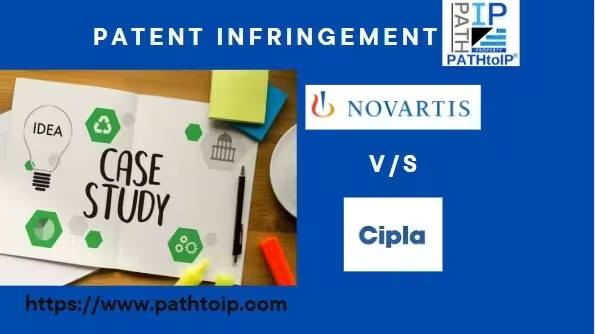
Case as an example
Novartis vs. Cipla
Novartis filed a case against Cipla for infringing their patents covering Onbrez (Indacaterol-drug used to treat chronic obstructive pulmonary disease) and sought damages.
The drug is protected by many (5) patents in India, which consist of product construction and process patents.
The case
In 2014, Cipla introduced a generic version of Onbrez and simultaneously filed a request to cancel Novartis’s patents.
Cipla argued that Novartis was not producing the drug domestically and instead imported only limited quantities through a licensee.
Then Novartis filed a case before the Delhi HC claiming patent infringement and damages.
Result In the Court
The Delhi High Court prohibited Cipla from producing or selling a generic copy of Novartis’s drug by issuing a temporary injunction in favor of the Plaintiff.
Conclusion:
In the case of infringement of the patent, the court shall not issue a grant against the defendant., if the defendant can explain that at the time of the infringement, they were unaware and had no Patent Infringements Infringements valid reasons to believe that the infringed patent existed.
The Indian Patent Act, 1970 provides several remedies to address patent infringement.
Source:
At PATHtoIP®, we ensure that every client receives exceptional results through high-quality patent research. Patent Infringements As an experienced firm, we are dedicated to providing patent protection and delivering results capable of reaching your goals.
Stay connected with PATHtoIP for the latest insights on patents, trademarks, copyrights, innovation, and IP strategy. Follow us on LinkedIn, Instagram, Facebook, X , Pinterest, YouTube, and Quora for expert guidance, industry updates, case studies, and practical tips to protect your innovations.