Introduction
Can a small local restaurant continue using a brand name that is also associated with a globally recognised fast-food company? This question became the centre of a significant trademark dispute between Burger King Corporation, the American fast-food chain, and a Pune-based restaurant operating under the name “Burger King.”
The dispute attracted attention because both businesses claimed rights over an identical name. While Burger King Corporation relied on its international reputation and trademark registrations, the Pune-based restaurant relied on its claim of earlier and continuous use of the name in India.
The case highlights an important principle of Indian trademark law: prior use can be a significant factor in determining trademark rights, even when another business holds a trademark registration.
The litigation also demonstrates why businesses should conduct trademark searches, maintain evidence of brand use, and develop a clear intellectual property strategy before entering new markets.
Burger King Corporation (BKC) – Plaintiff
The Burger King Corporation is based in Miami, Florida, & was founded in 1954 by James McLamore & David Edgerton.
- BKC operates over 13,000 fast-food restaurants in more than 100 countries, with most run by independent franchisees.
- The Burger King trademark, is registered in over 122 countries & is well-known globally.
- BKC owns various other trademarks & domain names, making it a significant player in the fast-food industry.
Pune-based Burger King – Defendant (Burger King Pune)

- Pune Camp Burger is a local fast-food restaurant located in Pune, India, & has been serving the community since 1992.
- The restaurant is owned by Anahita & Shapoor Irani who established it to offer quality burgers & other fast-food items.
- Despite its modest scale compared to global chains, it has gained local recognition & built a loyal customer base.
Case Study
 Grounds for Refusing the Application of Plaintiff

Overview of the Burger King Trademark Dispute
- The Burger King case in Pune underscores the critical need to grasp trademark law in India, especially the Doctrine of Prior Use. This principle safeguards the rights of businesses that have used a trademark first, even if it is later registered by another.
The disagreement eventually led to a lengthy legal battle that began in 2011.
Parties Involved
| Particulars | Details |
|---|---|
| Plaintiff | Burger King Corporation |
| Defendants | Anahita Irani and Shapoor Irani |
| Plaintiff’s business | International fast-food restaurant chain |
| Defendants’ business | Pune-based restaurant operating as Burger King |
| Main issue | Trademark infringement and passing off |
| Original court | District Court, Pune |
| Main legislation | Trade Marks Act, 1999 |
- Emphasizing the “first to use” principle helps avoid legal disputes and supports fair competition, particularly benefiting smaller businesses.
- For companies entering the Indian market, understanding both local and international trademark regulations is vital for preserving brand integrity.
- Effective management of intellectual property is key to achieving long-term success in India’s dynamic market.
-
The Burger King trademark case between Burger King Corporation and a Pune-based restaurant is one of India’s most discussed trademark disputes. The case highlights the legal complexities surrounding trademark registration, prior use, and brand protection under the Trade Marks Act, 1999.
-
This represents the conflict between a globally recognized fast-food brand and a local business that claimed prior use of the “Burger King” name in India. The dispute illustrates that trademark registration alone does not always determine ownership. Courts may also consider factors such as prior adoption, continuous commercial use, goodwill, and the likelihood of consumer confusion before reaching a decision.
-
The case serves as an important lesson for startups, entrepreneurs, and established businesses about the value of conducting trademark searches, securing registrations early, maintaining proper records of brand use, and developing a proactive intellectual property strategy. It also demonstrates how trademark rights can vary across jurisdictions and why businesses expanding into new markets should carefully evaluate existing rights before launching a brand.
- Understanding this landmark trademark dispute helps businesses appreciate the importance of protecting brand identity, avoiding infringement risks, and strengthening their intellectual property portfolio in today’s competitive marketplace.
The Pune District Court Decision
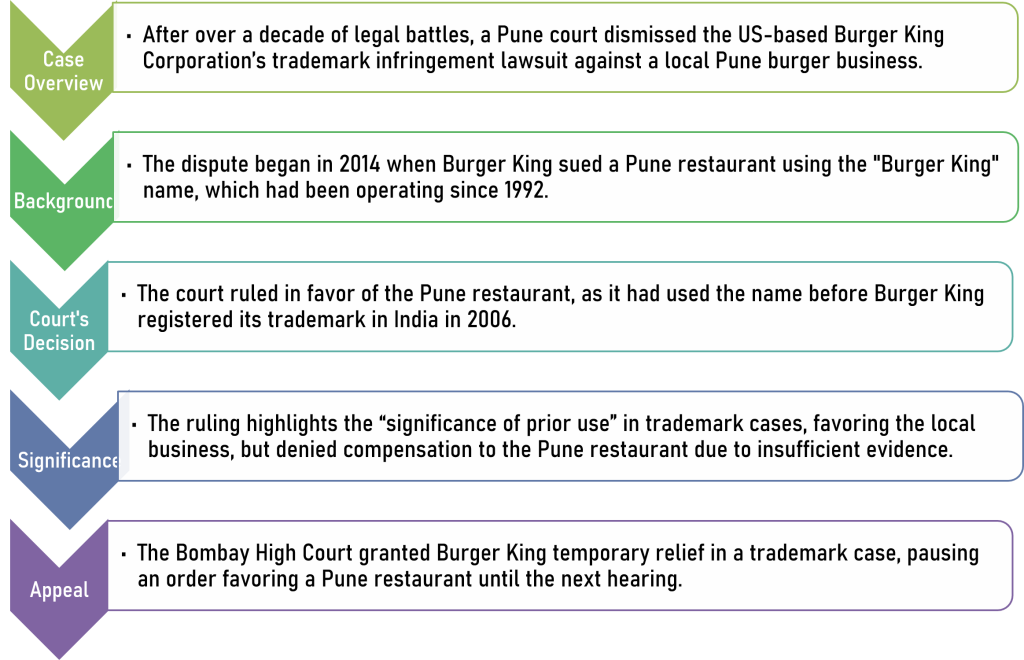
In July 2024, the Pune District Court dismissed Burger King Corporation’s suit.
The decision was delivered by District Judge Sunil Vedpathak. The court considered the evidence and arguments relating to the parties’ use of the disputed trademark.
The court accepted the significance of the Pune restaurant’s earlier use, noting that it had been using the name for restaurant services since approximately 1991–92, whereas Burger King Corporation began providing restaurant services under the mark in India in 2014.
The court also considered the corporation’s failure to sufficiently establish the alleged infringement and consumer confusion in the circumstances of the case.
The dismissal meant that the corporation did not obtain the permanent injunction and damages it had sought in the original suit.
Why was this decision significant?
The decision brought attention to the distinction between trademark registration and prior use.
A business may possess a registered trademark, but the legal position can be affected by another party’s evidence of continuous use from an earlier date. The Trade Marks Act, 1999 recognises this principle through Section 34.
Importantly, the Pune District Court’s decision was subsequently challenged, so it should not be treated as the final resolution of the entire dispute.
Proceedings Before the Bombay High Court
Burger King Corporation challenged the Pune District Court’s decision before the Bombay High Court.
On 26 August 2024, the High Court recorded that the original suit had been dismissed and considered the corporation’s application for interim relief.
The matter then continued through further proceedings.
On 2 December 2024, the Bombay High Court stayed the Pune court’s order and granted interim relief restraining the local restaurant from using the disputed “Burger King” trademark.
This changed the immediate legal position of the Pune restaurant.
The High Court’s intervention was an interim development in the appeal. It was not, by itself, a final determination of all the underlying trademark issues.
The Supreme Court’s Interim Order
The Pune restaurant owners challenged the Bombay High Court’s restraint order before the Supreme Court of India.
On 7 March 2025, the Supreme Court passed an interim order staying the Bombay High Court’s impugned order.
The Supreme Court also clarified that the pendency of the special leave petition would not prevent the Bombay High Court from deciding the appeal as expeditiously as possible.
As a result, the Pune restaurant was permitted to continue using the disputed name while the relevant proceedings remained pending, subject to the applicable court orders.
Case Status: What Happened Next?
The dispute continued before the Bombay High Court and the Supreme Court.
A Bombay High Court order dated 17 December 2025 recorded that the connected commercial first appeals would be treated as part-heard and listed for directions.
A further procedural update located during research, dated 26 October 2026, indicated that the Supreme Court matter remained pending and was expected to be listed for further hearing on 11 December 2026.
Therefore, the dispute should not be described as finally decided. The Supreme Court’s interim order and the earlier Pune District Court judgment are procedural and judicial developments, not a final nationwide ruling that resolves every aspect of the competing trademark claims.
Sources
Stay connected with PATHtoIP for the latest insights on patents, trademarks, copyrights, innovation, and IP strategy. Follow us on LinkedIn, Instagram, Facebook, X , Pinterest, YouTube, and Quora for expert guidance, industry updates, case studies, and practical tips to protect your innovations.