Introduction
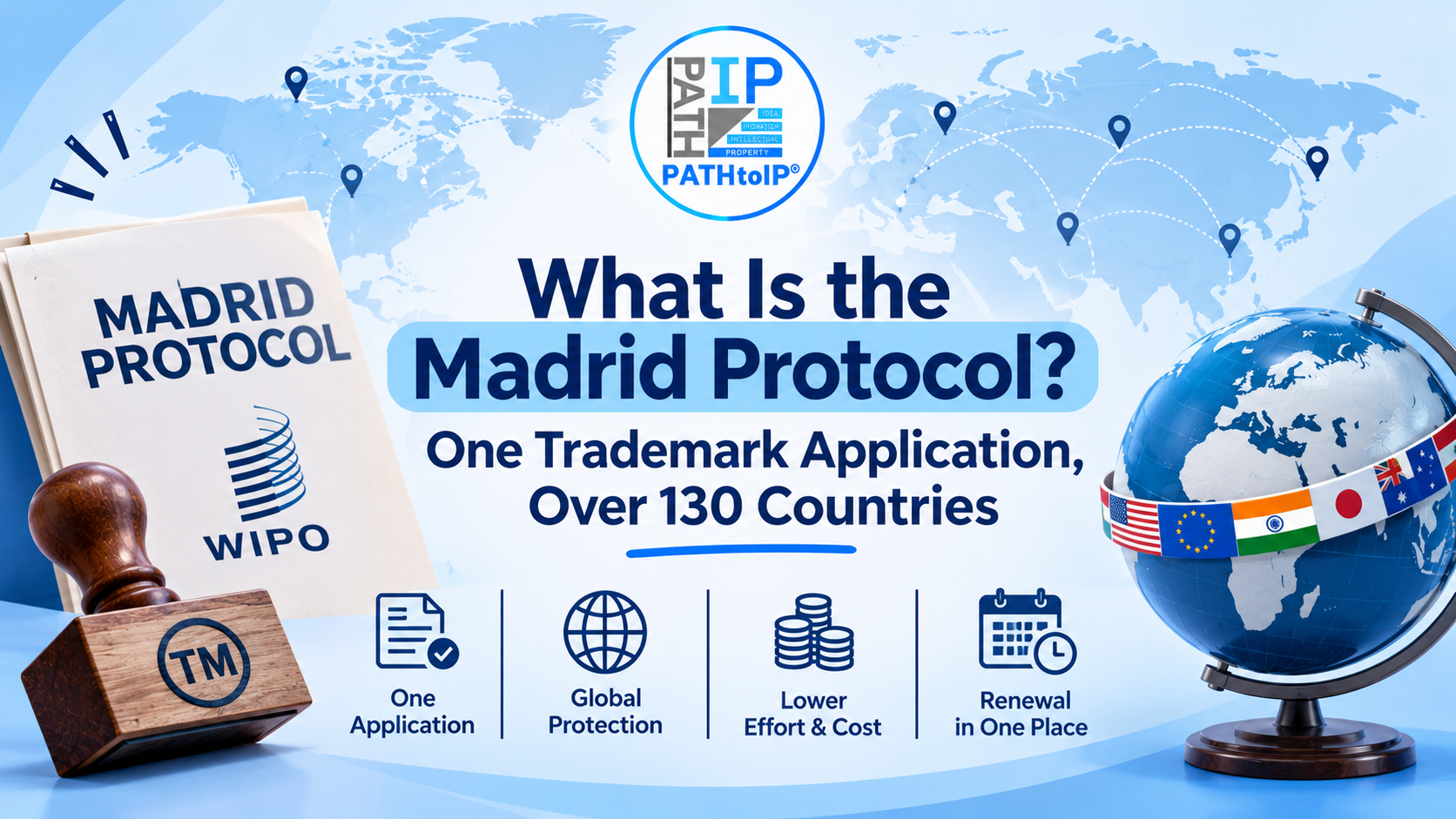
The Madrid Protocol is the international system that lets a brand owner register a trademark in many countries through one application, in one language, with one set of fees and one renewal. Without it, going global means filing separately in every country, with local attorneys, local forms and different deadlines each time. For a growing Indian brand, that quickly becomes expensive and hard to manage.
This article explains how the Madrid Protocol works, what the process looks like, and the risks Indian applicants should know about.
What Is the Madrid Protocol?
The Madrid Protocol is part of the Madrid System for the International Registration of Marks, administered by WIPO. The system rests on two treaties: the Madrid Agreement of 1891 and the Madrid Protocol, adopted in 1989 and operating since 1995. Today, most members, including India, are party to the Protocol. Over 110 members covering more than 130 countries are in the system.
As with the earlier treaties in this series, one point needs to be clear: there is no such thing as a “world trademark”. The Madrid System does not grant rights itself. It is a single route for filing and managing applications. Each country you designate examines your mark under its own law and decides whether to protect it.
Why Use the Madrid System?
- One application: You file once, in one language (English, French or Spanish), at your home trademark office.
- Lower cost and effort: You pay one set of fees to WIPO, plus any fees charged by individual countries, rather than hiring a local attorney in each country at the start.
- One portfolio: Renewals, changes of owner or address, and new country additions are done centrally with WIPO.
- Flexibility: You can add more countries later, using the same international registration.
How the Madrid Process Works?
Step 1: A base mark: You must first have a trademark application or registration in your home country. This is called the basic mark.
Step 2: Filing the international application: You file through your home trademark office, called the office of origin. In India, this is the Trade Marks Registry. The office certifies that your international application matches your basic mark, and forwards it to WIPO. You choose the countries where you want protection.
Step 3: WIPO examination: WIPO checks the formalities, mainly the goods and services classification and the fees. If everything is in order, it records the mark in the International Register, publishes it, and notifies each country you designated.
Step 4: Examination by each designated country: Each country’s trademark office examines the mark under its own law. It has a fixed period, usually 12 months and in some countries 18 months, to refuse protection. If it does not, your mark is protected in that country, as if you had filed there directly.
Step 5: Protection and renewal: International registration lasts 10 years and is renewed centrally through WIPO.
The Key Risk: Dependency on the Basic Mark
This is the part many applicants overlook. For the first five years, your international registration depends on your basic mark. If the basic application or registration is refused, withdrawn, cancelled or invalidated in that period, the international registration falls too, in all designated countries at once. This is sometimes called “central attack.”
If that happens, the registration can be converted into separate national applications in the countries concerned, and these keep the original date. But it means extra cost and the risk of losing protection in some countries. After five years, the international registration becomes independent of the basic mark.
A Worked Example
Suppose an Indian food brand has filed a trademark application in India and now wants protection in the US, the EU, Japan and Australia.
- It files one international application through the Trade Marks Registry, designating those four territories.
- WIPO checks the formalities and sends the designations to each office.
- Australia and Japan accept the mark. The US office raises an objection. The brand responds through a local US attorney.
- Once the objection is resolved, the mark is protected in all four. Renewal is a single filing at WIPO after 10 years.
- Two years in, the brand decides to enter the UK and adds it to the same international registration.
If the Indian application were refused in year three, the international registration would be at risk in all four territories. That is why the strength of the basic mark matters.
Madrid Protocol and the Paris Convention
The two work together. The Paris Convention gives you a priority period of 6 months for trademarks, so a Madrid international application filed within six months of your first application can claim the earlier date. Madrid then gives you the single filing route for the countries you want. Priority protects the date, and Madrid handles the filing.
Classification: Where Nice Fits In
Every Madrid application must list goods and services, grouped under the Nice Classification, the international system of 45 classes. A badly chosen description can narrow your protection or cause refusal in some countries. India joined the Nice Agreement in 2019, so Indian filings already use this system.
India and the Madrid Protocol
India acceded to the Madrid Protocol on 8 April 2013, and it came into force for India on 8 July 2013.
In practice:
- Indian brands filing abroad: can file an international application through the Trade Marks Registry, based on an Indian application or registration, and designate other member countries.
- Foreign brands entering India: can designate India in an international registration. The Indian Trade Marks Registry then examines it under the Trade Marks Act, 1999, which includes provisions for international registrations (see Chapter IVA) and the related Rules.
Check the details of India’s forms, fees and timelines with your attorney before filing, since the rules and fee schedules are updated from time to time.
Common Misconceptions
“A Madrid filing gives me a trademark in every country.”
It does not. Only the countries you designate, and only those that accept the mark.
“I don’t need local attorneys at all.”
Not always. If a country raises an objection or an opposition is filed, you will usually need a local representative to respond.
“My international registration is independent from the start.”
It is not. It depends on the basic mark for five years.
“It is always cheaper.”
Madrid is often cheaper and simpler for several countries, but fees add up per country, and for just one or two countries a direct national filing can be cheaper.
“Every country is a member.”
No. Always check the current member list on WIPO’s website.
How PATHtoIP Helps
PATHtoIP supports brand owners through the international trademark process:
- Reviewing the strength of the basic Indian mark before going international
- Choosing the right countries and classes for your budget and plans
- Filing and managing the international application and priority claims
- Handling objections and oppositions through a network of local counsel
- Tracking renewals and deadlines across your portfolio
Conclusion
The Madrid Protocol is the most practical route for an Indian brand that wants to protect its name in several countries without managing separate filings. Its main weakness is the five-year dependency on the basic mark, so the strongest strategy is to secure a solid Indian filing first.
In the next article, we look at the Hague Agreement and how it handles international design registration.
Stay connected with PATHtoIP for the latest insights on patents, trademarks, copyrights, innovation, and IP strategy. Follow us on LinkedIn, Instagram, Facebook, X , Pinterest, YouTube, and Quora for expert guidance, industry updates, case studies, and practical tips to protect your innovations.
Frequently Asked Questions
What is the Madrid Protocol in simple terms?
It is an international system, run by WIPO, that lets you apply for trademark protection in many countries with one application, filed through your home trademark office.
Do I need an Indian trademark before using Madrid?
Yes. You must have a trademark application or registration in India, called the basic mark, and your international application must match it.
How long does international trademark protection last?
10 years from the international registration date, renewable every 10 years through WIPO.