Introduction
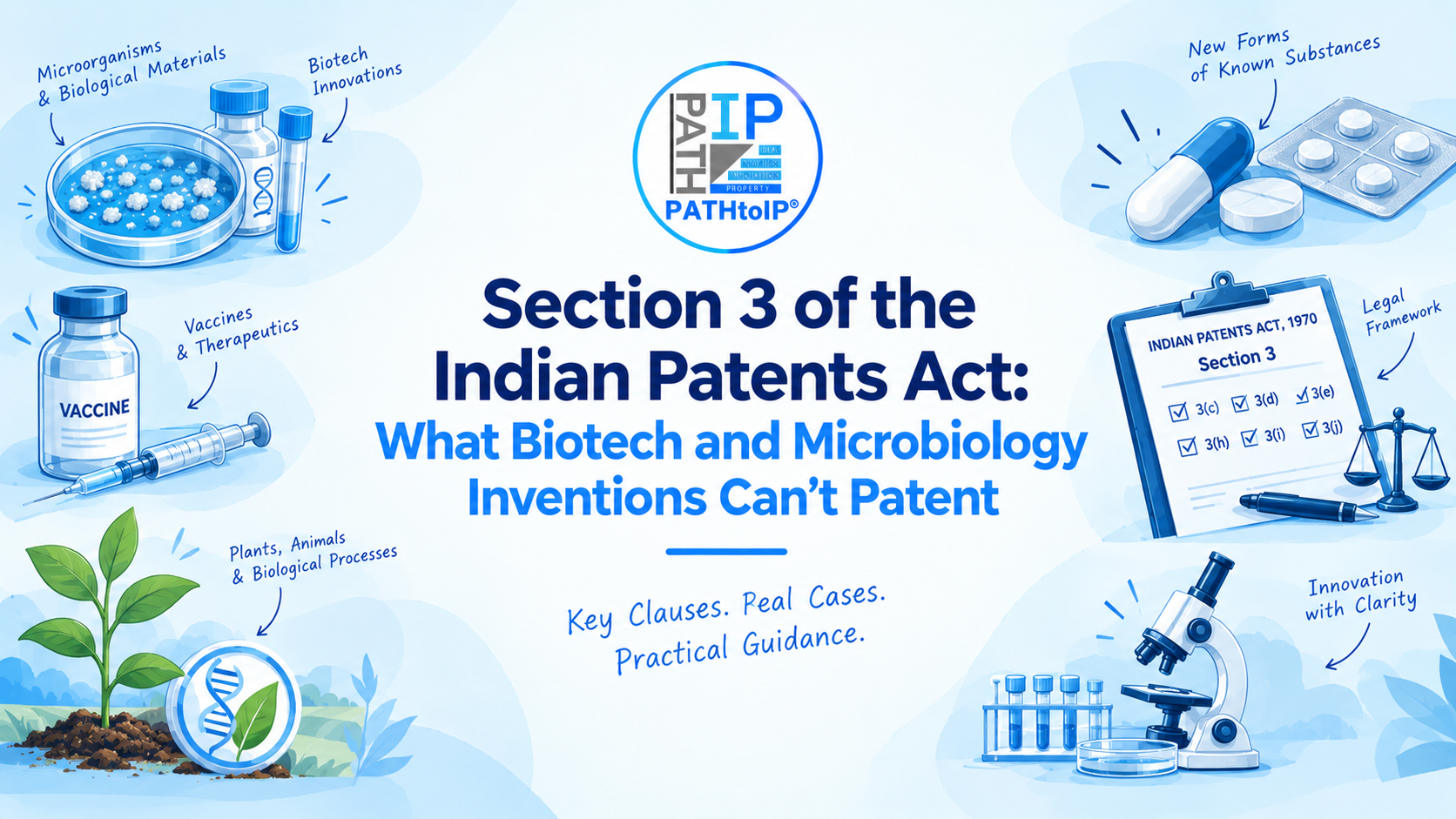
Not every invention that is scientifically valuable can be patented in India, and Section 3 of the Indian Patent Act, 1970 is where many biotech and microbiology applications first run into trouble.
What Is Section 3 of the Indian Patents Act, 1970?
Every year drug companies and biotech firms create medicines, test kits, techniques, for making new genes, plants or animals that have been changed in a lab, vaccines, special proteins, good bacteria and mixtures of microbes. Before something can be checked to see if it’s new, if it’s an idea and if it can be used in business it has to first pass the rules in Section 3. This part of the law tells what is not considered an invention and therefore cannot be protected by a patent.
Which Section 3 Clauses Matter for Biotechnology and Microbiology?
So why does Indian patent law reject inventions that look scientifically valuable?
Six clauses are most important for microbiology and biotechnology: 3(c) 3(d) 3(e) 3(h) 3(i) and 3(j).
Together these clauses cover occurring organisms, new forms of known substances, simple mixtures, farming methods, methods of medical treatment and plants, animals and essentially biological processes.
Recent court decisions on technologies, GMOs and biochemical inventions show how Section 3 is being read in modern biotechnology. This blog walks through each clause explains the case law behind Section 3 and shows how applicants can address the objection.
Section 3(c): Can a Naturally Occurring Microorganism Be Patented in India?
Section 3(c) states that simply discovering a principle creating an abstract theory or finding any living or non‑living substance in nature does not count as an invention.
This creates an obstacle in the fields of biotechnology and microbiology.
Examiners may argue that an isolated microorganism or biological material is simply a discovery of something that already exists, not an invention
Case Law: Regents of the University of California v. Controller of Patents (2025)
The application, no. IN201717005699 was titled ‘Vaccine for Livestock Production Systems. Claimed to be a genetically engineered (recombinant) Salmonella microorganism for use in a live vaccine. The Delhi High Court (C.A.(COMM.IPD-PAT) 481/2022 decided 21 February 2025) upheld the Patent Controllers refusal. It held that the claims were drawn broadly that they could also cover naturally occurring loss-of-function variants of Salmonella, which falls under Section 3(c). It also held that the specification did not sufficiently describe the invention, under Sections 10(4) and 10(5) including all the claimed mutations and noted that the recombinant strain had not been deposited.
How to Overcome a Section 3(c) Objection?
The claimed subject matter must be shown to be human made, not something that was simply found in nature. Applicants should provide evidence of substantial human intervention. This can include methods like engineering, recombinant DNA technology or other laboratory modifications. Such interventions should result in material, with improved or distinctly different characteristics compared to naturally occurring counterparts. The evidence should demonstrate how the human-made process led to these changes.
Example: Isolated Strain vs. Engineered Strain
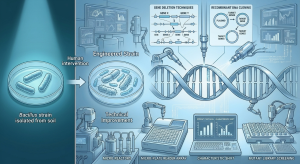
A claim to a “Bacillus strain isolated from soil” will probably trigger a 3(c) objection. A claim, to a strain that has engineered gene deletions, supported by a detailed description of those modifications and where required a deposit of the strain clearly shows the human contribution and is far easier to defend.
Section 3(d): Why Are New Forms of Known Drugs Not Patentable?
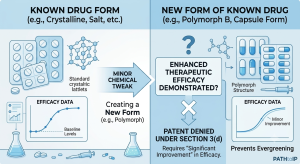
Section 3(d) says that simply finding a form of a substance that is already known and does not make the substance work better is not allowed. It also says that just finding a property or a new use for a substance that is already known is not allowed. It also says that just using a process or a machine or an apparatus that is already known is not allowed, unless that process creates a product or uses at least one new reactant.
This provision appeared in the 2005 amendment designed to stop evergreening. Evergreening occurs when small tweaks to an existing drug are used to extend patent protection. The amendment denies a patent for forms of known substances unless they display a significant improvement in therapeutic efficacy.
Section 3(e): When Is a Mixture of Known Ingredients Patentable?
Section 3(e) excludes a substance that comes from an admixture that merely gathers the properties of its components and Section 3(e) also excludes a process that produces such a substance.
Case Law: UPL Limited v. The Controller of Patents (2024)
In UPL Limited v. The Controller of Patents (Calcutta High Court, 2024) the court made it clear that a composition should not be rejected under Section 3(e) only because it uses known ingredients. The key point is whether the combination produces an effect. That effect must be proven with scientific evidence.
For applicants the real takeaway is this: if you claim synergy, you must support it with data. The data should clearly show how the composition works better, than the sum of its parts. Without that proof the claim may not hold.
Section 3(h): Are Agricultural and Horticultural Methods Patentable?
Section 3(h) says a method of agriculture or horticulture is not an invention. It keeps conventional farming and gardening practices free for everyone to use.
Case Law: Decco Worldwide Post Harvest Holdings B.V. v. Controller of Patents and Designs
In Decco Worldwide Post Harvest Holdings B.V. v. Controller of Patents and Designs, the Calcutta High Court clarified that a technical process for controlling post-harvest fungal disease is not merely a ‘method of agriculture’. Such a process can be patented if it meets the requirements of novelty, inventive step and industrial applicability.
Section 3(i): Can Methods of Treatment and Diagnosis Be Patented?
Section 3(i) excludes any process for the medicinal, surgical, curative, prophylactic, diagnostic, therapeutic or other treatment of human beings. It also excludes similar processes for treating animals to free them of disease or to increase their economic value or that of their products.
The purpose is to let doctors, veterinarians and other healthcare professionals provide care without the risk of patent infringement.
Case Law: Allergan Inc. v. Assistant Controller of Patents and Designs (2023)
In Allergan Inc. v. Assistant Controller of Patents and Designs (2023), the Delhi High Court reaffirmed that treatment methods are not patentable, but pharmaceutical products and compositions must be examined on their own and are not automatically excluded.
How to Overcome a Section 3(i) Objection?
Draft claims to patent-eligible products, such as drugs, vaccines, formulations, medical devices or in vitro diagnostic technologies, instead of methods of treatment or diagnosis.
Section 3(j): Are Plants, Animals and Biological Processes Patentable?
Section 3(j) excludes plants and animals in whole or in part, including seeds, varieties and species, and essentially biological processes for producing or propagating plants and animals. Microorganisms are the exception: they can be patented if they are novel, involve an inventive step and are industrially applicable.
Key Case Law on Section 3(j)
Two decisions show how courts read this clause:
- Dimminaco AG v. Controller of Patents and Designs (Calcutta High Court): a process is not excluded merely because it produces a living product, provided it is novel, inventive and industrially applicable.
- Monsanto Technology LLC v. Nuziveedu Seeds Ltd. (Supreme Court): whether Section 3(j) applies must be decided after carefully examining the nature of the claimed invention.
Taken together, these decisions suggest that biotechnology inventions involving significant human intervention, such as genetically engineered microorganisms, may be patentable. Naturally occurring plants, animals and essentially biological processes remain excluded.
How to Overcome a Section 3(j) Objection?
Draft claims for human-made products and processes such as a synthetic process, isolated DNA or a Protein Ather, then the whole organism.
For plant varieties protection must be requested under the Protection of Plant Varieties and Farmers’ Rights (PPVFR) Act, 2001 not the Patents Act.
Conclusion
Section 3 does not stop progress. It wants people who apply for patents to clearly show what makes the invention more than finding something new. They need to prove there is work involving a technical improvement, a helpful effect on health, a better working together of parts or a use in industry depending on what the invention is.
A clear and properly written description, lab results and carefully written claims can usually fix problems with Section 3. As biotechnology keeps changing with methods like making DNA from different sources, genetically modified organisms, vaccines, tests and bacteria-based inventions, knowing about Section 3 and how the courts keep explaining it will stay very important for getting good, strong and legal patent protection, in India.
Facing a Section 3 objection, or planning to patent a pharma, biotech or microbiology invention in India? PATHtoIP can help with patentability assessment, patent drafting and responses to examination reports.
Get in touch with PATHtoIP today to discuss your invention.
Stay connected with PATHtoIP for the latest insights on patents, trademarks, copyrights, innovation, and IP strategy. Follow us on LinkedIn, Instagram, Facebook, X , Pinterest, YouTube, and Quora for expert guidance, industry updates, case studies, and practical tips to protect your innovations.
Frequently Asked Questions
Can microorganisms be patented in India?
Yes. Section 3(j) makes an exception for microorganisms, which can be patented if they are novel, involve an inventive step and are industrially applicable. Naturally occurring microorganisms can still face a Section 3(c) objection, so the claim should show human intervention.
Why are patent applications rejected under Section 3(d)?
Section 3(d) rejects new forms of known substances that do not show enhanced therapeutic efficacy. It was introduced in 2005 to prevent evergreening.
Can a method of medical treatment be patented in India?
No. Section 3(i) excludes methods of treatment and diagnosis. Claims directed to drugs, vaccines, formulations, medical devices or in vitro diagnostics can be patented.
How are new plant varieties protected in India?
Through the Protection of Plant Varieties and Farmers’ Rights (PPVFR) Act, 2001, not the Patents Act.
How can an applicant overcome a Section 3 objection?
By showing human intervention, technical advancement, therapeutic efficacy or synergy, backed by experimental data and well-drafted claims.