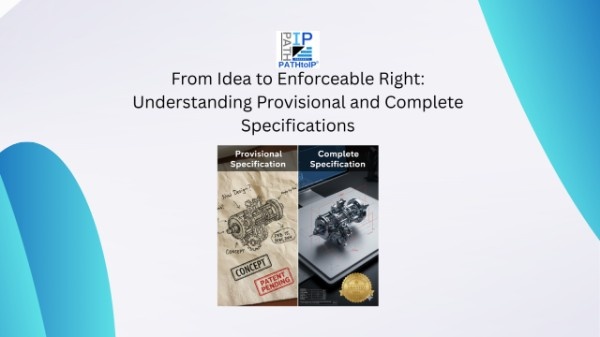
From Idea to Enforceable Right: Understanding Provisional and Complete Specifications
How the first filing decision shapes patent strength
Patent protection does not commence at the stage of grant; it begins with the initial filing of a patent application before the Indian Patent Office. Under the Indian Patent Act, 1970, the form of specification filed at this stage significantly influences the scope and enforceability of patent rights. Section 9 governs the filing of a provisional specification and requires submission of a complete specification within twelve months to maintain the priority date. Section 10 sets out the requirements for a complete specification, including full disclosure of the invention and clearly defined claims. Therefore, the decision to file a provisional or complete specification directly affects the priority date under Section 11, as well as the overall strength and sustainability of the patent. This discussion examines the differences between Provisional Patents and Complete Patents, their statutory basis, and their strategic significance within the Indian patent filing framework.
Provisional specification
A provisional specification is an initial, temporary patent filing used when your invention is still being developed or tested. It allows you to secure an early filing (priority) date with the Indian Patent Office without needing full technical details or formal claims.
Understanding Provisional and Complete Specifications
Content & Limitations
A provisional specification does not demand the same level of detail as a complete specification, but it must still clearly explain the invention. Typically, it should include:
- Title of the invention – A brief and precise title reflecting the nature of the invention
- Basic description – A clear explanation of the core concept and essential features
- Supporting drawings (if required) – Simple diagrams to help understand the working principle
However, unlike a complete specification, a provisional filing does not require:
- Formal patent claims
- Detailed experimental data or working examples
- Exhaustive technical parameters
- A structured abstract
This makes provisional filing suitable when the invention is still evolving.
That said, “less detail” does not mean “insufficient detail.” The disclosure must still be clear enough so that a person skilled in the relevant field can understand the invention’s fundamental idea. If the description is too vague, the priority benefit may be at risk when filing the complete specification.
Complete specification
A complete specification is the full and final patent document that clearly explains the invention in detail and defines the exact scope of legal protection through claims. It is the document that is examined by the Indian Patent Office and serves as the basis for granting a patent.
Filing Requirements & Deadlines
- A complete specification must be filed within 12 months of a provisional filing, failing which, the application is treated as abandoned and the priority date is lost. This timeline is strictly enforced.
- It may be filed either as a follow-up to a provisional or directly, without a provisional. However, any subject matter not disclosed in the provisional will not benefit from its earlier priority date.
Strategic Comparison: Which path to choose for filing?
While both filings serve the same end goal, the decision depends on the current stage of innovation:
Choose a Provisional Specification if:
- In a competitive “race to file” against market rivals.
- Invention is still undergoing minor technical refinements.
- Need to test market viability or seek investors before committing to high legal costs.
Choose a Complete Specification if:
- The invention is fully developed, and no further changes are expected.
- Wants to fast-track the examination process to get a grant sooner.
- All the experimental data and working examples are ready to file.
Example of a provisional and complete specification
An inventor develops a smart irrigation system for farms.
In a provisional specification, they describe the core concept, such as sensors that detect soil moisture and automatically control water flow.
In the complete specification, they provide detailed system architecture, sensor calibration methods, control algorithms, hardware configurations, alternative embodiments, and clearly drafted claims defining the exact scope of protection.
The Bottom Line
The 12-month period between filing a Provisional and a Complete Specification is not merely a waiting phase; it serves as a strategic window to refine the invention and align intellectual property protection with evolving business objectives. However, it is important to remember that the robustness of the eventual patent depends largely on the clarity and completeness of the initial disclosure.

Conclusion
The framework of provisional and complete specifications gives inventors the flexibility to protect their ideas at different stages of development. A provisional filing helps secure an early foothold, while a complete specification converts that early step into enforceable and clearly defined legal rights. Understanding when and how to use each route allows innovators to align their patent strategy with technical progress, market readiness, and available resources. Ultimately, strong protection is not just about filing; it is about filing thoughtfully and strategically from the very beginning. Provisional and Complete Specifications
At PATHtoIP LLP, we assist innovators at every stage of their patent journey, from drafting strong provisional specifications to preparing precise and enforceable complete specifications. Our team ensures that the invention is disclosed clearly, strategically, and in full compliance with Indian patent requirements. Whether it is a startup securing an early priority date or a business seeking robust long-term protection, we provide practical guidance and end-to-end support.
Stay connected with PATHtoIP for the latest insights on patents, trademarks, copyrights, innovation, and IP strategy. Follow us on LinkedIn, Instagram, Facebook, X , Pinterest, YouTube, and Quora for expert guidance, industry updates, case studies, and practical tips to protect your innovations.