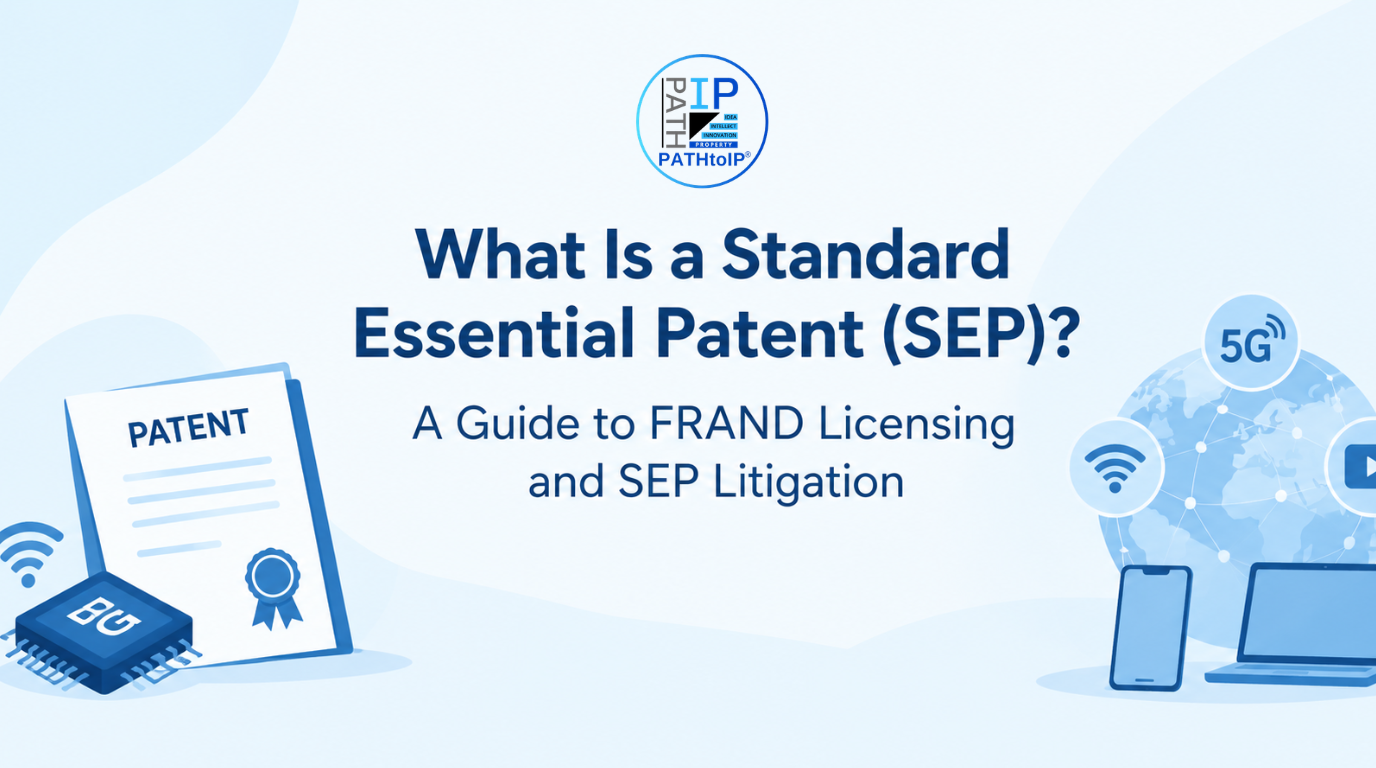
Defining a Standard Essential Patent (SEP Litigation)
A Standard Essential Patent is a type of patent that covers technology that must be used when creating products that follow an industry standard. Examples of standards include 4G, 5G, Wi-Fi which is also known as 802.11 and video compression methods, like H.264 and HEVC. Most patents can be avoided by inventors who find ways to create the same function. A real Standard Essential Patent does not allow that. If a product needs to meet the standard it has to use the technology.
This is what makes a SEP different from a patent, in real-world use. A regular patent lets the owner stop others from using a way of doing something.. A SEP gives the owner power over a whole group of products. That’s because following the standard is often required to sell a product. For example a 5G chip that doesn’t actually work with 5G can’t be sold. So the SEP holder can influence the market in a broader way.
How Patents Become “Essential”
SEPs do not begin as essential. They become part of a standard through a process that is organized by groups known as standard-setting organizations. These groups include ETSI, which’s the European Telecommunications Standards Institute. Another group is 3GPP, which’s the Third Generation Partnership Project. This group creates standards such, as 5G. There is also IEEE, which controls Wi-Fi standards and many other standards.
The process generally works like this:
- Companies contribute technical proposals during standard development
- If a company believes a pending or granted patent covers technology that may be required to implement the resulting standard, it self-declares that patent as essential to the SSO
- In exchange for having their technology built into the standard, the declarant commits to license the patent on FRAND terms (explained below)
Critically, most SSOs, including ETSI do not independently check whether a patent is essential when it is declared. A declaration is a one‑sided good‑faith statement made by the patent holder. That is why the difference between patents that are declared essential and patents that are actually essential is so big. Independent studies that looked at 5G declarations sent to ETSI show that about 20 to 30 percent of declared patent families are truly essential when they are tested against the final standard. The other patents may be invalid not needed for compliance or declared defensively as a precaution.
The FRAND Commitment
FRAND means Fair, Reasonable and Non-Discriminatory. It is the licensing framework that SEP holders agree to when they declare a patent essential. FRAND is designed to solve a problem. If a patent is locked into a standard the holder could otherwise have too much power to block competitors or demand unreasonable royalties. FRAND is the compromise that makes standardization possible. Implementers can access the technology and patent holders receive fair compensation for their contribution.
In practice, FRAND disputes tend to center on two recurring questions:
What counts as a “fair and reasonable” royalty rate?
FRAND is a concept, not a set number and smart people and judges often have opinions on how to figure it out. Some use the down method others look at similar licenses and some focus on the added value. All of these approaches are used regularly.
At what level of the supply chain should licensing happen?
This is the component-level versus end-device-level licensing debate. I think the chipmaker faces a choice: should the chipmaker license a SEP directly for the chip it manufactures or should the company selling the finished phone license the SEP for the full device? This dispute was central to cases like TCL, v. Ericsson. It continues to split SEP holders and component manufacturers.
Patent Hold-Up and Patent Hold-Out
Two opposing risks shape most SEP licensing disputes:
- Patent hold-up: A SEP holder uses the threat of an injunction or an order that stops the sale of a product that does not follow the standard to demand royalty rates that are far higher than the real value of the patented technology. The SEP holder benefits from the fact that the implementer is locked into the standard making it hard for the implementer to switch away and the SEP holder can keep extracting royalty rates that’re well above what the patented technology is actually worth.
- Patent hold-out (also called “reverse hold-up”): An implementer deliberately uses SEP-protected technology without a license. The implementer delays negotiation on purpose believing that the cost of settling in court or losing is lower than paying a royalty upfront.
Much of SEP case law, including the two cases, is really about balancing the power, between the risks of using SEP-protected technology and the costs of licensing.
Case Study 1: Huawei v. ZTE (CJEU, 2015)
The Court of Justice of the European Union made a ruling in the case Huawei Technologies v. ZTE. That ruling created a framework that is still used across Europe today. It helps determine when an essential patent holder trying to get an injunction might be abusing its dominant market position under EU competition law.
The court outlined a process for negotiations. First the patent holder must inform the alleged infringer. Then it must offer a license on reasonable and non-discriminatory terms, known as FRAND terms. On the other hand, the implementer must respond in a serious way. If the implementer does not agree with the offer it must propose its FRAND terms. Only if the implementer does not negotiate in faith can the patent holder go ahead and seek an injunction. Otherwise the patent holder could be seen as abusing its market power.
This case gave both sides a path to follow. It also gave courts a way to judge whether a patent enforcement action is legitimate or whether it amounts to a patent hold-up. The decision helped balance the rights of the patent holder with the interests of competition in the market.
Case Study 2: Unwired Planet v. Huawei (UK Supreme Court, 2020)
Where Huawei v. ZTE set the conduct standard, Unwired Planet, v. Huawei ([2020] UKSC 37) answered a question: can a national court set license terms for a SEP holder’s entire global portfolio, not just the patents valid in that country?
Unwired Planet held SEPs it said Huawei was using without a license. Huawei argued it should only need to license Unwired Planets UK-registered patents. The UK Supreme Court disagreed, ruling that UK courts have jurisdiction to determine the terms of a FRAND license and that an implementer who refuses to accept those court-determined terms can face a UK sales injunction. The ruling cemented the UK as a forum where a national courts decision can effectively set worldwide licensing terms reshaping where global SEP disputes get litigated.
Why This Matters Beyond Telecom?
SEP and FRAND issues are no longer limited to smartphones. As IoT devices, connected vehicles and smart manufacturing equipment depend on standards such as 5G and Wi-Fi companies that have never worked in telecom patent licensing are now entering SEP negotiations for the first time. These companies often lack knowledge about FRAND valuation or how to handle SSO declaration processes. Knowing how to assess essentiality rates deals with disputes over licensing levels. Understanding the hold-up and hold-out problems is no longer just important for telecom OEMs. It is important for any company that sells a product.
How PATHtoIP Helps
PATHtoIP advises clients on SEP portfolio strategy, from essentiality analysis and SSO declaration practices to FRAND licensing negotiation support and freedom-to-operate assessments for SEP Litigation companies entering standards-reliant product categories for the first time.
Stay connected with PATHtoIP for the latest insights on patents, trademarks, copyrights, innovation, and IP strategy. Follow us on LinkedIn, Instagram, Facebook, X , Pinterest, YouTube, and Quora for expert guidance, industry updates, case studies, and practical tips to protect your innovations.
Frequently Asked Questions
Does declaring a patent essential to an SSO mean it's actually essential?
Not necessarily. Most SSOs, including ETSI, don’t independently verify essentiality at declaration; it’s a self-declared, good-faith statement. Independent analysis of 5G declarations estimates only around 20–30% of declared patent families are likely genuinely essential.
Can a SEP holder always get an injunction against an infringer?
No. Because SEP holders have committed to FRAND licensing, courts in major jurisdictions, following frameworks like the one set in Huawei v. ZTE generally require the SEP holder to follow a good-faith negotiation process before an injunction is available, specifically to prevent patent hold-up.
Who decides what a "fair and reasonable" royalty actually is?
When parties can’t agree, courts increasingly do, as in Unwired Planet v. Huawei, where a national court set global FRAND license terms. There’s no single accepted formula; courts have used comparable-license, top-down, and incremental-value methodologies depending on the case and jurisdiction.