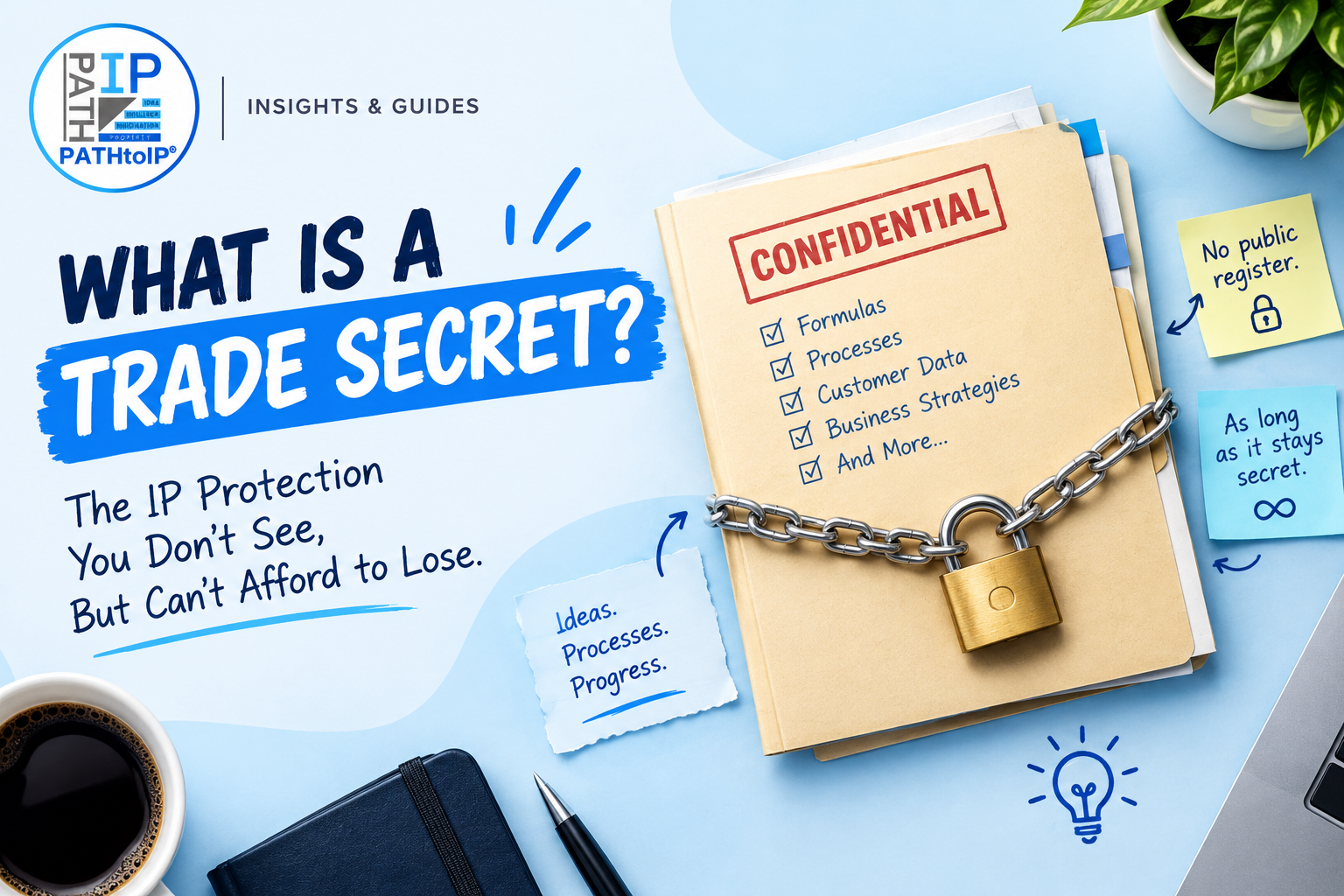
When people think of intellectual property, patents, trademarks, and copyrights usually come to mind first. But one of the most commercially powerful forms of IP protection doesn’t require filing a single application, doesn’t show up in any public register, and can, in theory, last forever. It’s called a trade secret, and some of the world’s most valuable companies have built entire business empires around protecting one.
What Is a Trade Secret?
A trade secret is confidential business information that provides a competitive edge specifically because it isn’t publicly known. Unlike patents, which require public disclosure of an invention in exchange for a time-limited monopoly, trade secrets stay protected only for as long as they stay secret.
For a piece of information to legally qualify as a trade secret, it generally has to meet three conditions:
- It’s not generally known to the public or to competitors who could benefit from it.
- It has commercial value because it is secret.
- Reasonable steps have been taken to keep it confidential, think NDAs, restricted access, encryption, and internal confidentiality policies.
Trade secrets can cover an enormous range of information: formulas, manufacturing processes, source code, customer lists, pricing strategies, marketing plans, supplier relationships, and even internal know-how that isn’t written down anywhere formal.
How Trade Secrets Differ From Patents
The choice between patenting an invention and protecting it as a trade secret is one of the most important strategic decisions a company makes, and the two paths work very differently.
| Aspect | Patents | Trade Secrets |
| Disclosure | Full public disclosure required | Information stays confidential |
| Duration | Fixed term (20 years from filing) | Indefinite, as long as secrecy is maintained |
| Registration | Formal application and examination | No registration required |
| Protection scope | Legal monopoly, enforceable against independent discovery | Protects only against misappropriation, not independent discovery or reverse engineering |
| Cost | Filing, prosecution, and maintenance fees | Cost of maintaining confidentiality (contracts, security) |
| Risk | Protection expires; details become public | Protection ends instantly if secrecy is lost |
This is why companies often make a deliberate choice: patent an invention when it can be reverse-engineered anyway (so disclosure costs little), and keep something a trade secret when the underlying process would be extremely difficult for a competitor to figure out independently.
Real-World Examples: When Trade Secrets Make or Break a Business
The Formula That Never Got Patented: Coca-Cola
Perhaps the most famous trade secret in the world is the formula for Coca-Cola’s flavoring, known internally as “Merchandise 7X.” Coca-Cola made a deliberate decision over a century ago not to patent the formula, because a patent would have required disclosing the exact recipe and would have expired decades ago. Instead, the company relies on strict internal secrecy, the complete formula is reportedly known to only a handful of people at any given time, and it has remained protected for well over 130 years, far longer than any patent could have lasted.
KFC’s Eleven Herbs and Spices
Similarly, KFC has protected its blend of eleven herbs and spices as a trade secret rather than a patent since the 1940s. The company reportedly splits the spice-mix production between two different suppliers so that no single manufacturer ever has the complete recipe, illustrating how “reasonable steps to maintain secrecy” can be built directly into a supply chain.
Waymo v. Uber: When a Trade Secret Walks Out the Door With an Employee
Not every trade secret story ends well for the company that owns it, which is exactly why enforcement matters. In one of the most closely watched trade secret disputes of the last decade, Google’s self-driving car unit, Waymo, accused Uber of misappropriating its confidential LiDAR (laser-sensing) technology. Waymo alleged that a former engineer, Anthony Levandowski, downloaded roughly 14,000 confidential files before leaving to start his own self-driving venture, which Uber acquired shortly afterward. The case went to trial in 2018 and settled five days in, with Uber agreeing to give Waymo a 0.34% equity stake valued at roughly $245 million, along with a commitment not to use Waymo’s confidential information in its self-driving technology. The case remains a textbook example of how trade secret risk concentrates around departing employees, and why exit protocols and confidentiality agreements matter as much as the secrecy measures themselves.
DuPont v. Kolon Industries: A Trade Secret Theft With Criminal Consequences
Trade secret misappropriation isn’t limited to Silicon Valley software, it happens in heavy manufacturing too. DuPont accused South Korea’s Kolon Industries of stealing trade secrets behind Kevlar, DuPont’s high-strength aramid fiber used in body armor, by hiring former DuPont employees who brought confidential manufacturing know-how with them. A jury initially awarded DuPont $919.9 million in 2011 in what was then one of the largest trade secret verdicts in U.S. history. After an appeal sent the case back for retrial, the dispute was ultimately resolved through a 2015 settlement in which Kolon agreed to pay $275 million in restitution alongside separate criminal fines, after pleading guilty to conspiracy to steal trade secrets. The case shows that trade secret theft can carry both civil liability and criminal exposure when it crosses into deliberate corporate espionage.
Trade Secrets in the Indian Legal Landscape
India does not currently have a standalone trade secrets statute. Protection instead comes from a combination of contract law under the Indian Contract Act, 1872, principles of equity, and common law remedies for breach of confidence. Indian courts have nonetheless enforced trade secret protections in several notable disputes involving departing employees and confidential client or technical information, reinforcing that well-drafted confidentiality and non-disclosure agreements remain the primary line of defense for Indian businesses, since there’s no government registry to fall back on the way there is for patents or trademarks.
Why Businesses Should Take Trade Secret Protection Seriously
- No expiration date: unlike patents, a trade secret can, in principle, protect an asset forever.
- No disclosure risk to the public register: the exact process, formula, or method never has to be revealed.
- Broad coverage: trade secrets can protect things that wouldn’t qualify for patent protection at all, like customer data or business strategies.
- But the protection is fragile: a single leak, whether accidental or through employee departure, can permanently destroy the secret and the legal protection along with it.
How PATHtoIP Helps
Protecting a trade secret is fundamentally different from protecting a patent or trademark , there’s no filing deadline to track, but there is constant risk management. PATHtoIP helps businesses build and maintain that protection through:
- Drafting and reviewing robust NDAs and confidentiality agreements tailored to employees, vendors, and business partners
- Advising on the patent-versus-trade-secret decision for new inventions and processes
- Structuring internal confidentiality policies and access controls
- Supporting IP audits to identify which business assets should be protected as trade secrets versus filed as patents
- Assisting with enforcement strategy if a trade secret is misappropriated
FAQs
- Can I patent something and also treat parts of it as a trade secret?
Yes. Companies often patent the parts of an invention that would be easy to reverse-engineer anyway, while keeping supporting know-how, like optimized manufacturing parameters, as a trade secret, since those details aren’t disclosed in the patent application.
- What happens if a trade secret becomes public accidentally?
Once information genuinely enters the public domain, trade secret protection is lost, there’s no way to “re-secure” it, which is why prevention through contracts and access controls is so critical.
- Do trade secrets need to be registered in India to be protected?
No. India has no trade secret registry. Protection relies entirely on contractual confidentiality obligations and common law principles, so a strong NDA is the closest thing to formal protection a business can put in place.