What Is a Patent ?
No matter where your discussion on drug pricing, generics, or exclusivity leads, at some point you are likely to hear mention of a “patent thicket.” This is one of those phrases that is used quite casually, either neutrally or pejoratively. Knowing precisely what it means is crucial for anyone involved in the world of pharma research and development, intellectual property strategy, and market access.
Defining the Patent Thicket
In other words, a patent thicket can be defined as a web of overlapping patents on a product or technology created not in one patent but in several layers in sequence, surrounding a product or a technology. Not a patent for a molecule but an array of secondary patents is filed by a company in such a way that when another company seeks access to the market, it has to deal with numerous patents rather than one.
This term was coined to refer to those cases where overlapping patents, rather than strong patents themselves, became a problem for entering the market.
How Thickets Form: The Anatomy of Secondary Patents
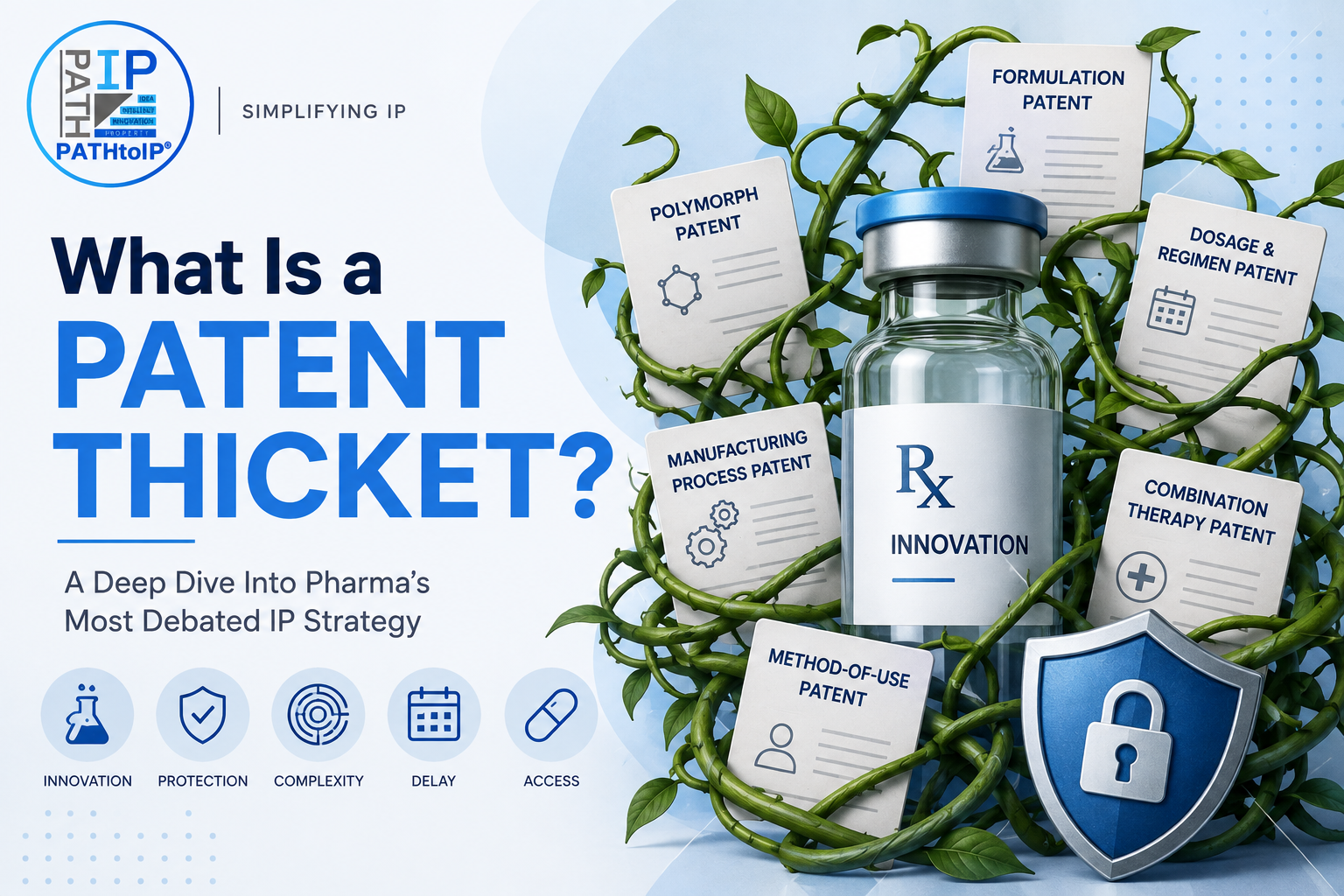
In the field of pharmaceuticals, a thicket often emerges around a core composition-of-matter patent (which covers the active molecule) in the following areas:
- Formulation patents: concerning specific delivery systems, excipients, or extended-release formulations
- Dosage and regimen patents: referring to specific dosing regimens that have proven to be effective
- Polymorph and crystalline form patents: pertaining to particular forms of the same active substance
- Manufacturing process patents: covering the process of synthesis or purification of the compound on a large scale
- Combination therapy patents: which covers the molecule used together with other active substances
- Method-of-use patents: expanding the use of an existing drug to treat new patients
Each of these patents may be applied for years after the original composition-of-matter patent is filed using continuation applications. On their own, each of these patents may be fully valid, as it describes an actual and non-obvious improvement on the product. As a group, however, these patents can give the product additional market protection beyond the 20-year protection period.
The Term You’ll Hear Alongside It: Evergreening
Evergreening is the process most commonly linked with patent thickets, involving multiple secondary patents to extend the exclusivity period beyond that which would be granted by the primary patent alone. Evergreening is a highly controversial concept: while patent owners see it as innovative progress, antitrust authorities and others see it as an attempt to delay the introduction of generics or biosimilars without providing any further therapeutic value.
The legal ramifications of this controversy cannot be overstated since regulatory and judicial scrutiny of the validity of such secondary patents has become increasingly common over the years, and this question is often explicitly posed in obviousness-type double patenting proceedings and in terminal disclaimers required during the patent application process.
A Real-World Case Study: Humira
Humira (adalimumab) from AbbVie is the quintessential case. The core composition-of-matter patent on the adalimumab molecule expired in 2016. But at this time, AbbVie had a network of 132 other patents covering formulations, administration schedules, and manufacturing processes for the drug.
Result: despite the regulatory approval of competing biosimilar drugs long before 2016, there were no biosimilar versions of Humira available in the U.S. market until 2023, nearly seven years after expiration of the core patent, following resolution of patent litigation with AbbVie and establishing a schedule of entry dates.
(Interestingly, biosimilar drugs were available in Europe starting in 2018 due to the stricter approach of patent authorities in Europe toward secondary pharmaceutical patents.)
This transatlantic difference is usually cited when discussing the issue of thickets precisely because it exemplifies the effect of the thicket: identical molecule, identical expiration of core patent, dramatically different competitive time frames.
Why It Matters: Innovation Incentive vs. Anti-Competitive Effect
Patent thickets sit at a genuine tension point in IP policy:
The case for them:
- Secondary innovation, improved formulation, safer administration, and more convenient dosage regimen do have some clinical significance
- If not for the exclusivity incentive for improvements, some post-launch R&D will never take place
- All thickets are not bad faith evergreening; some actually represent genuine and separately patentable improvements.
The case against them:
- Patent thickets may prevent affordable access to generics/biosimilars even after the expiration of patents.
- The fact that it would take money and resources to fight against many patents rather than just one patent acts as a deterrent to market entry.
- They can be a Freedom-To-Operate (FTO) minefield as well since even if a company feels confident that it can challenge one patent, it does not mean that it has the capacity to fight all of them.
How Regulators and Competitors Respond
A few mechanisms exist specifically to counter thicket-driven delay:
- Inter parties review (IPR): permits third parties to contest the validity of secondary patents before the USPTO without the need for litigation
- Patent dance procedures (under the U.S. BPCIA): an organized disclosure procedure intended for allowing biosimilar manufacturers to find out which patents are being asserted against them, rather than dealing with the whole patent portfolio blind
- FTC and antitrust scrutiny: Inquiries have been opened by the U.S. and EU competition regulators regarding whether particular thicket strategies (especially involving insulin and biologics) amount to anti-competitive behavior.
- Stricter secondary-patent standards: some patent offices (such as India’s Section 3(d)) do not allow the patenting of new uses or forms of known materials unless there is an obvious improvement in efficacy, for precisely this reason
Why This Matters for Companies Building Pharma IP Strategy
The thicket phenomenon is more than a defensive consideration for originators; it defines the way the patent thicket is designed in the first place, what secondary innovations are worthy of patent protection, in what countries enforcement is feasible, and how the filing schedule impacts expiration dates. For generic and biosimilar manufacturers, the thicket determines the freedom-to-operate analysis and market entry timeline long before the launch.
How PATHtoIP Helps
PathToIP has expertise in working with innovators in the pharmaceutical and biotechnology sector in relation to IP strategies pertaining to thicket through all phases, ranging from creation of secondary patents for the formulation and process of manufacturing, carrying out FTO This is one of those phrases that is used quite casually, either neutrally or pejoratively. analysis prior to entering the market with generics or biosimilars, to determining jurisdiction-specific standards of patentability.
Stay connected with PATHtoIP for the latest insights on patents, trademarks, copyrights, innovation, and IP strategy. Follow us on LinkedIn, Instagram, Facebook, X , Pinterest, YouTube, and Quora for expert guidance, industry updates, case studies, and practical tips to protect your innovations.
Frequently Asked Questions
Is a patent thicket illegal?
Not inherently. Filing multiple legitimate patents around a product is standard IP practice. Legal risk arises when patents are asserted in bad faith, are found invalid on obviousness grounds, or when the strategy is found to violate antitrust law, not from the existence of multiple patents itself.
How is a patent thicket different from a patent cluster?
The terms are often used interchangeably, but “patent cluster” is typically the neutral, descriptive term (many related patents around one technology), while “patent thicket” more often implies the cluster functions as a barrier to competitor entry.
Can a patent thicket be challenged before litigation?
Yes, mechanisms like inter partes review (IPR) at the USPTO, and pre-grant or post-grant oppositions in other jurisdictions, allow specific patents within a thicket to be challenged for validity without waiting for infringement litigation.