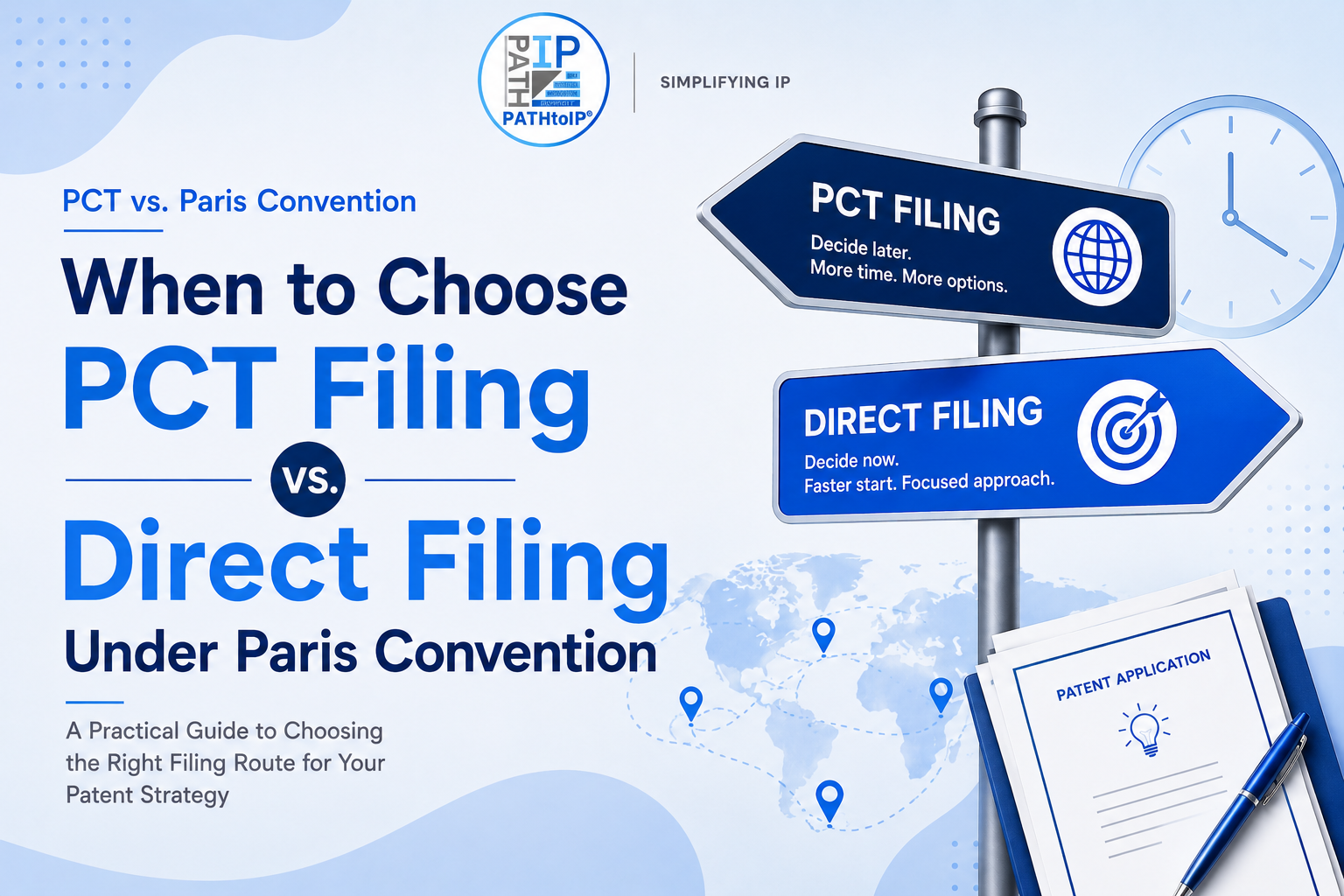
PCT Filing vs Direct Filing?
Both routes start from the place, which is the first filing and the Paris Convention priority clock is ticking down. The difference between the two routes is what you do with this clock. You can spend the time deciding. You can spend the time filing.
The Paris Convention priority clock is important for the filing. Neither of the two routes is better than the other. Each route is good for a kind of applicant. This is a guide to help you figure out which route is good for your situation and which one fits your needs, for the filing and the Paris Convention priority.
The Core Trade-Off
Direct filing under the Paris Convention: Filing separately in each target country within the 12-month priority window means that you file in each country and claim the filing date. This way you can get started in each country faster. The cost, at the beginning, is usually lower. However you have to pay for each country’s fees and translations and hire agents all within those same 12 months and all at the same time. This can be a lot to handle. Filing separately in each target country within the 12-month priority window is a job.
PCT filing: Means filing one application within the same 12-month period then putting off the decision for each country and the costs that go along with it until 30 or 31 months from the original priority date. The initial PCT filing fee is more than a direct filing, but it gives 18 extra months to prepare before most of the national-phase expenses start happening.
Put simply: Paris Convention direct filing front-loads decisions and costs into 12 months; PCT spreads them out to 30.
When Direct Filing Is the Better Fit
You already know exactly where you’re filing
If the list of countries we are targeting is truly set, for example India and the United States because those are where manufacturing is and where the main customers already are there is no real choice left to put off. So, paying for the PCTs phase adds cost but doesn’t add value.
You’re targeting a small number of countries, generally two or three
When you think about the costs of the phase, the PCT and direct filing are pretty much the same for a few countries. The more countries you add to the list the more the PCT costs make sense. The PCT is really useful when you have a lot of countries. For a number of countries, the PCT is not that helpful. The PCT and direct filing costs are similar, for a few countries but the PCT costs are better when you have many countries.
Speed to grant matters more than flexibility
When you do a filing, it can really speed things up. Some countries even have programs that help you get your patent granted faster. This is really useful when you are working on something and you need to protect it quickly. In a field where things are moving fast it is better to get your patent granted sooner. This way you have a patent that you can enforce. That is worth more than having extra time to think about it. Direct filing is an option because it can get you a grant faster, than using the PCT route.
Some target countries aren’t PCT members at all
Not every country has joined the Patent Cooperation Treaty. Taiwan is an example of this for people who want to do business in Asia and the Pacific. If a company really needs to sell something in a market that is not part of the Patent Cooperation Treaty they have to file for a patent in that country directly using the Paris Convention no matter what they do in other places. The Patent Cooperation Treaty is important for companies that want to sell things in countries, so they need to think about the Patent Cooperation Treaty when they make their plans.
When PCT Filing Is the Better Fit
You’re still deciding where to file, or the list might grow
The main thing about the PCT is that it gives people a lot of time to think. Normally people have to decide which countries they want to sell their product in within a year. With the PCT people have thirty months to make this decision. This is really helpful because people can take their time to look at the market, get the money they need or do research and development.
Then they can decide which countries they want to sell their product in based on information rather than just guessing. The PCT gives people a thirty-month window to make this decision and that is a really good thing. The PCT is about giving people time and options and that is its core value proposition.
You’re targeting a broad set of countries, generally five or more
When you go beyond that point it becomes really expensive and complicated to file with all of them at the same time within 12 months. The PCT is better because it allows you to spend the amount of money over a much longer period of time. This makes the PCT a manageable option for the Patent Cooperation Treaty process because the PCT spreads the cost of the Patent Cooperation Treaty over a longer time frame instead.
You want an early, independent read on patentability
The International Search Report and Written Opinion come in before the 30-month deadline. This gives a signal. The signal is based on art. The applicant may not have found this on their own. It shows whether the claims are likely to be valid. This happens before the applicant has to spend money on national-phase costs in all places.
You want simplified early-stage administration
One app, one filing day one group of steps instead of working with different filings, translations and local lawyers in many countries all at the same short time.
A Middle Path: Hybrid Strategy
These two options don’t always have to be separate. A typical way for people who have one or two places they really want to focus on and bigger goals elsewhere is to apply directly in those places. This helps get a national review where it’s already decided. At the time they can also file a pct filing fees application. This keeps the choice open for countries that are not yet certain. It costs more than picking one path but it allows the person to act quickly where they are sure and keep options open where they are not.
A Note for Indian Applicants Specifically
Before Indian applicants can go ahead with either route, they have to think about something. They need to get a Foreign Filing License, which is also known as Form 25 under Section 39 of the Indian Patents Act. This is important because Indian applicants are not allowed to file an application in another country if they have already filed an application in India and it has been more than six weeks.
The only exception is if the invention has nothing to do with defense or atomic energy. This rule applies to both the Paris Convention filing and the PCT route. It is like a barrier that Indian applicants have to go through before they can proceed with either route.
So Indian applicants should plan for this from the beginning. Don’t wait until it is too close to the deadline. The Foreign Filing License is a step for Indian applicants, and they should make sure to get it before filing an application abroad.
Quick Decision Guide
| Factor | Favors Direct Filing | Favors PCT |
| Number of target countries | 2–3 | 5+ |
| Certainty about target markets | Already decided | Still deciding |
| Budget timing preference | Lower upfront, less flexible | Higher upfront, deferred |
| Need for early patentability feedback | Not a priority | High priority |
| Urgency to reach grant | High | Lower, flexibility matters more |
| Target includes a non-PCT country | Required for that country | N/A for that country |
How PATHtoIP Helps
Deciding on a route is not that simple. It depends on the target market. How stable is the market? How countries are we really talking about? What about the Foreign Filing License? This is important for people from India.
PATHtoIP helps client’s figure this out before time runs out. They can also come up with a plan that combines filing and PCT filing. This way both methods can work together. PATHtoIP does this, for applicants. The clock starts ticking and PATHtoIP makes sure Indian applicants are ready.
Stay connected with PATHtoIP for the latest insights on patents, trademarks, copyrights, innovation, and IP strategy. Follow us on LinkedIn, Instagram, Facebook, X , Pinterest, YouTube, and Quora for expert guidance, industry updates, case studies, and practical tips to protect your innovations.
Frequently Asked Questions
Is PCT filing always more expensive than direct filing?
Not necessarily overall, it’s more expensive upfront, but because it defers national-phase costs by 18 months, the total cost across many countries often ends up comparable to, or even lower than, direct filing everywhere at once, once financing timelines are factored in.
Can I switch from one route to the other after filing?
Not really, the two routes are chosen at the 12-month priority deadline itself. Once that window closes without either a PCT filing or the necessary direct national filings, the priority claim is generally lost for any country not yet filed in.
Do I need a Foreign Filing License even if I’m filing through the PCT rather than directly in another country?
Yes, for Indian applicants, Section 39’s Foreign Filing License requirement applies to filing abroad generally, including through the PCT, not just to direct national filings. It’s a precondition that sits in front of either route.