What is the Application Data Sheet?
The Application Data Sheet is a form that people fill out when they want to apply for a patent in the United States. This form is called the Application Data Sheet or the ADS for short. The Application Data Sheet is also known as Form PTO/AIA/14.
The Application Data Sheet is used to give information about the patent application. The United States Patent and Trademark Office, which is also called the USPTO needs this information. The Application Data Sheet is used for types of patent applications. The Application Data Sheet can be used for a patent application or a nonprovisional patent application.
The rules for the Application Data Sheet are found in a book of rules. This book of rules is called 37 CFR 1.76. These rules say when the Application Data Sheet can be used. The Application Data Sheet can be used when someone is applying for a patent application under 35 U.S.C. 111(B). The Application Data Sheet can also be used when someone is applying for a patent application under 35 U.S.C. 111(A).
The Application Data Sheet is similar to a form used in India. This form is called Form 1. The Application Data Sheet is the form we are looking at in a series of comparisons, between Indian and US patent forms. We are comparing the Application Data Sheet to forms used in India and the United States.
What the Application Data Sheet captures
The Application Data Sheet is a form that has lots of information: it has the details of the person who is applying the details of the inventor, the information about where to send letters the details of the application the information about the representative the claims for domestic benefit and foreign priority and the information about the assignee. All of this is organized under the headings that are listed in 37 CFR 1.76(b).
Why does the Application Data Sheet matter as a record?
The Application Data Sheet is not a simple cover page. Some parts of it have special importance in the eyes of the law under 37 CFR 1.76(d).
For the claims of priority and the claims of domestic benefit the Application Data Sheet that was filed most recently is the one that controls, even if there is conflicting information in other documents that were filed.
For other information the general rule under 37 CFR 1.76(d)(1) is that the most recently submitted document is the one that governs when there is a conflict. This could be the Application Data Sheet or it could be the address that was designated for correspondence under 37 CFR 1.33(a), or it could be the oath or declaration of the inventor under 37 CFR 1.63. But there is one exception to this rule: under 37 CFR 1.76(d)(2) the Application Data Sheet is the one that controls when the conflicting information was supplied at the time as the oath or declaration or the correspondence address.
The naming of inventors and the changes to this information are not part of this framework. They are governed by 37 CFR 1.41 which says who can be an inventor and 37 CFR 1.48 which says how to correct or change the information about the inventors after the application has been filed.
In practice this means that the Application Data Sheet is the document that you need to get right and you need to update it promptly with a supplemental Application Data Sheet. Especially when it comes to the claims of priority because if the benefit claim is incorrect or missing it can cause problems with the priority date even if the rest of the application is valid.
When Is the ADS Required?
The ADS is not always needed.
Under 37 CFR 1.53 the filing date for an application is fixed by the date a specification is received. The ADS is not part of that test.
A provisional application gets its filing date on receipt of the specification and any required drawings. It still needs a cover sheet identifying it as provisional.
That cover sheet can be an ADS or a simple cover letter. So, an ADS is not the way to satisfy it.
A missing ADS on its own won’t cost you the filing date.
What it can cost you is:
- Priority and benefit claims
- A Customer Number for correspondence
- Inventor information
- When It Becomes Essential
There are two situations where the ADS’s mandatory:
Claiming priority or benefit.
A claim for priority or domestic benefit must be presented in an ADS.
Presenting the priority claim in the ADS is what constitutes the claim.
You can’t just mention the application elsewhere in the specification.
Deferring the inventor’s oath or declaration.
If you want to postpone filing the inventor’s oath or declaration
an ADS containing the required inventor information is mandatory at filing.
USPTOs Recommendation
The USPTO recommends filing an ADS with every application.
It standardizes data in a format the Offices systems can capture automatically.
This reduces the risk of a mismatch, between what’s on file and what’s on the filing receipt.
What Happens Without One?
If no Application Data Sheet or ADS is filed and no special situation applies the application can still move forward. The required information must be found in other documents like the inventor’s oath or declaration. This is slower and more prone to mistakes for the Office to handle.
Missing or inconsistent information can delay getting a filing receipt. It can also make it harder to claim priority or benefits later. If some parts of the ADS are left blank the Office might think there is no information
What the ADS Contains?
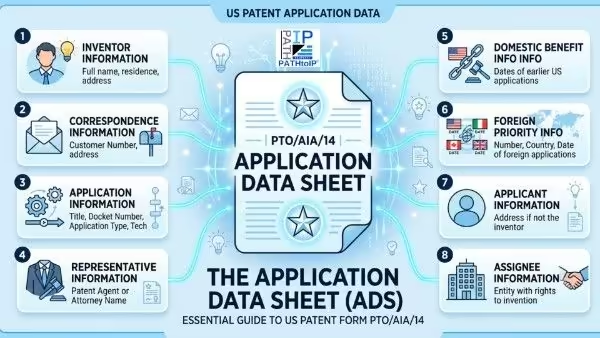
The ADS has eight sections. These are:
- Inventor Information
- The full name, where they live and their mailing address of each inventor.
- Correspondence Information
- A special USPTO. Their full mailing address.
- Application Information
- The title of the invention.
- The attorney’s docket number.
- The type of application. Whether it’s new or not.
- Suggested technology. Drawing figure for publication.
4. Representative Information
- The name of the patent agent or attorney who can act for the applicant.
- Domestic Benefit Information
- The. Dates of earlier US applications.
- Foreign Priority Information
- The number, country and date of applications for which priority is claimed.
7. Applicant Information
- The Address of the applicant if they are not the inventor.
8. Assignee Information
- The Address of the person or company with rights to the invention.
- The ADS must be signed by the applicant or an authorized patent practitioner. This confirms that the information provided is accurate.
Correcting or Updating an Application Data Sheet
The information in an Application Data Sheet is not final when you first submit it. According to the rules you can make changes to an Application Data Sheet at any time before you pay the issue fee. To do this you just need to submit an Application Data Sheet with the correct information.
There are types of changes that have their own special rules. For example, if you need to make changes to the list of inventors you have to follow the rules in 37 CFR 1.48. If you need to make changes to a claim for priority or benefit from an application, you have to follow the rules in 37 CFR 1.55 and 37 CFR 1. 78.. If you need to change the address where you want to receive mail you have to follow the rules in 37 CFR 1.33(a).
When you submit an Application Data Sheet to make changes you can include all the information or just the parts that have changed. If you only include the parts that have changed you need to mark what is new and what is deleted. You can do this by underlining the information and using strike-through or brackets for the deleted information.
It is also important to note that if you submit an Application Data Sheet after your application has been finally rejected or after you have received a notice that your patent will be allowed it may not be automatically accepted. In these cases, the rules in 37 CFR 1.116 and 37 CFR 1.312 will apply.
ADS vs. India’s Form 1: A Quick Comparison
| US Application Data Sheet (PTO/AIA/14) | India Form 1 | |
| Governing provision | 37 CFR 1.76 | Patents Act, 1970 & Patent Rules, 2003 |
| Mandatory? | Optional in most cases; mandatory for priority/benefit claims and deferred oaths | Mandatory with every application |
| Structure | Standalone bibliographic data sheet | Declaration-style application form |
| Priority claims | Presented in the ADS itself this act constitutes the claim | Declared in the application form |
| Amenability | Correctable any time before issue fee payment via supplemental ADS | Governed by separate procedural rules for amendment |
Where to Find It
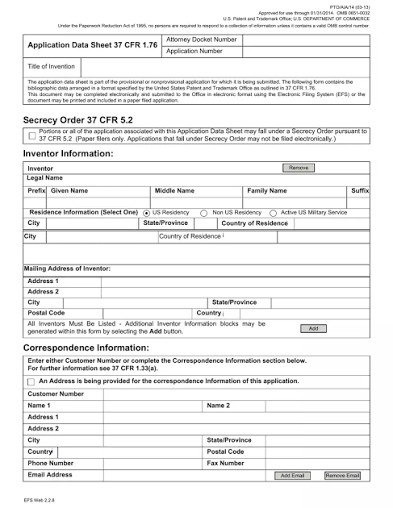
The Official Source is the USPTO Application Data Sheet which is also known as the PTO/AIA/14. You can find this at https://www.uspto.gov/patents/apply/forms.
Related Reading
The PTO/AIA/01 which’s the US Inventors Oath or Declaration will be covered next in this series.
Frequently Asked Questions
Is the Application Data Sheet the same as Form 1 in India?
The Application Data Sheet is not exactly the same as Form 1 in India. The Application Data Sheet covers the information like the applicant and the inventor and priority details, but it is structured as a standalone data sheet under 37 CFR 1.76
If I update priority information later which version of the Application Data Sheet controls?
The recently filed Application Data Sheet governs foreign priority and domestic benefit claims under 37 CFR 1.76(d)(1)(i). So, a later Application Data Sheet supersedes one on those points even if other documents, on file say otherwise.
Can I fix a mistake in my Application Data Sheet after filing?
Yes you can fix a mistake in your Application Data Sheet after filing. Under 37 CFR 1.76(c) a corrected or supplemental Application Data Sheet can be filed any time before the issue fee is paid. However inventorship and priority or benefit and correspondence address changes each follow their specific rule which are 37 CFR 1.48 and 1.55/1.78 and 1.33(a) respectively.