Introduction
Owning a patent does not mean you are free to sell the product it covers. A patent gives you the right to stop others from making, using or selling your invention. It does not by itself give you the right to make, use or sell that invention yourself because someone’s patent may still cover part of what you have built.
That gap is where two ideas come in: Blocking Patents and Freedom to Operate (FTO). This article explains both in language walks through a hypothetical example and shows how companies check where they stand before investing in a launch.
What Is a Blocking Patent?
A blocking patent is a patent that belongs to another person. The claims in that patent cover what you want to make or sell. You cannot legally sell your product in the country where that patent’s active until the patent ends or is no longer valid. You usually need the permission of the person who holds the patent to sell your product in that country.
It is about the claims, not the title
Patents are defined by the claims. The claims are the numbered statements at the end of the specification. Patents do not get their limits, from the title, the abstract or the general idea. A patent named “Improved Water Bottle” may have claims that’re far broader or narrower than the title suggests. The patent blocking is always judged claim by claim.
Why a new invention can still be blocked?
A common situation involves improvements. Company A patents a basic invention. Company B later improves on it and gets its own patent for the improvement. B’s patent can be perfectly valid, yet B’s product still contains everything A’s claims describe. Selling it would infringe A’s patent, so A’s patent blocks B.
A Hypothetical Example: The Patch That Could Not Launch
ABC Labs and XYZ Biotech are fictional companies created only to illustrate the concept. The patent numbers, dates and countries are invented.
The setup
ABC Labs invents a transdermal patch (a drug-delivery patch worn on the skin) and is granted a patent. Claim 1, in simplified form, reads:
A transdermal patch comprising (a) a polymer matrix, (b) a permeation enhancer, and (c) an adhesive layer.
Years later, a startup called XYZ Biotech develops a better patch. It has the same three components and adds a microneedle array that delivers the drug deeper into the skin. The microneedle feature is new and inventive, so XYZ Biotech is granted its own patent on the improved patch.
The problem
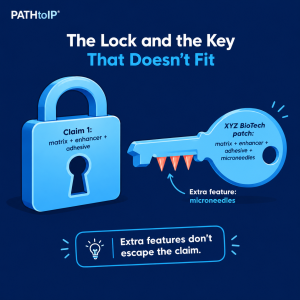
XYZ Biotech is ready to launch. They think its patent will clear the way. It does not. XYZ Biotech’s product contains a polymer matrix, a permeation enhancer and an adhesive layer, all of which’re in ABC Labs’ claim 1. Claims written with the word “comprising” are open‑ended; adding features, such as microneedles does not take a product outside the claim.
So, in a country where ABC Labs’ patents in force selling the XYZ Biotech’s would infringe ABC Labs’ patent.
ABC Labs’ patent is a blocking patent for XYZ Biotech even though XYZ Biotech holds a patent of its own.
The blocking can run both ways. ABC Labs’ cannot use XYZ Biotech’s microneedle improvement without XYZ Biotech’s permission, which’s why situations like this often end in a cross‑license.
What an FTO analysis would have shown?
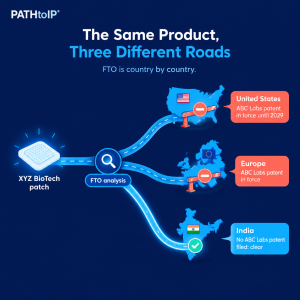
Had XYZ Biotech run an FTO analysis before investing in the launch, it would have found ABC Labs’ patent early and then looked at where it actually bites:
- Territory: Suppose ABC Labs’ patent was granted in the US and Europe but never filed in India. XYZ Biotech could manufacture and sell in India without infringing it, while the US and Europe would need a different plan.
- Time: Suppose the patent expires in 2029. Helix could plan a US launch for after expiry, or negotiate a license in the meantime.
- Design-around: If XYZ Biotech can replace the polymer matrix with a different structure that falls outside claim 1, it may avoid the patent altogether. This needs careful claim analysis, because some jurisdictions also consider equivalents.
- Validity: If earlier publications already disclosed what claim 1 covers, XYZ Biotech may have grounds to challenge the patent.
The lesson is not that XYZ Biotech did anything wrong by patenting its improvement. It is that having a patent and being free to sell are two separate questions, and the second one is best answered before the money is spent.
How Freedom to Operate Connects to Blocking Patents?
A blocking patent is the problem. A Freedom to Operate (FTO) analysis is how you find out, before launch, whether you have that problem in the countries that matter to you.
FTO is where blocking patents get found
Blocking patents rarely show up on their own. In the example XYZ Biotech couldn’t know from its patent applications that ABC Labs claims included its product. It takes a search of people’s patents and a careful look at how their claims match the product to find out.
FTO separates real blocks from false alarms
A patent that looks close is not automatically a blocking patent. It blocks only if all of the following hold:
- Its claims cover every element of your product
- It is in force, and not expired, lapsed or revoked
- It applies in the country where you plan to operate
Checking these three points is the core of FTO work, and it often shows that a worrying patent is not a problem in practice, as with ABC Labs’ missing Indian filing.
FTO turns a block into a decision
Once a blocking patent is confirmed, FTO also frames the response: license it, design around it, challenge it or wait it out. Those options are covered below.
How Is an FTO Analysis Carried Out?
The exact process varies by firm and by product, but a typical FTO analysis follows these steps:
- Define the product or process: List its features precisely. The analysis can only be as accurate as the description of what is being cleared.
- Choose the countries: Patents are national or regional rights, so the analysis is run for the markets where you plan to make, use, sell or import.
- Search: Look through granted patents and published applications in those countries, using keywords, classification codes and known competitors’ portfolios.
- Map claims to the product: Compare the claims of the relevant patents with your product, element by element. A patent is only a concern if the product falls within at least one of its claims.
- Check legal status: Confirm whether each patent is in force, or has expired, lapsed, been revoked or narrowed.
- Assess risk and options: Report which patents are a concern, how strong the risk is, and what can be done about it.
Common Misconceptions About FTO
“I have a patent, so I am free to sell.”
A patent is a right to exclude others, not a license to use your own invention. Someone else’s earlier or broader claims can still cover your product.
“If it is clear in one country, it is clear everywhere.”
FTO is territorial. A product can be clear in India and blocked in the US. Each country needs its own analysis.
“An FTO opinion is permanent.”
FTO is time-bound. New patents are granted and old ones expire or lapse, so an FTO result is a snapshot of a particular date. Long development cycles call for periodic updates.
“Only granted patents matter.”
Published applications matter too, because they may be granted later with claims that cover your product. Good FTO work keeps an eye on them. Applications are generally published about 18 months after filing, so very recent filings may not be visible yet.
“An FTO analysis is a guarantee.”
It is a risk assessment based on the search and the claim analysis. No search can be perfectly exhaustive, and claim interpretation can be contested.
What If You Find a Blocking Patent?
Finding one is useful information, not a dead end. The usual options are:
- License it: Negotiate permission from the patent owner, usually for royalties or other terms.
- Cross-license: If you hold patents the owner needs, the two sides can exchange rights. This is common when improvement patents and base patents block each other, as with ABC Labs and XYZ BioTech.
- Design around it: Change the product so that it falls outside every claim of the blocking patent.
- Challenge its validity: If the claims should never have been granted, procedures such as opposition, revocation or post-grant review may be available, depending on the jurisdiction.
- Wait for expiry: If the patent is close to the end of its term, timing the launch may be the simplest route.
- Acquire the patent: Buying the patent or the company that owns it removes the block entirely.
Which option fits depends on the strength of the patent, the commercial value of the product, the market, and the timeline.
Why FTO Matters for Startups and Founders?
For an early‑stage company FTO is a pre‑launch and pre‑funding question. Product development, trials, manufacturing setup and marketing all cost a lot. Finding a blocking patent after spending money is more expensive to fix than finding one before spending money. Investors also ask about FTO.
During diligence a founder who can say, “We have checked our freedom to operate in our target markets and here is what we found ” is in a stronger position than a founder who only has filed patents. It shows the team knows that a patent portfolio and a clear path to market are not the same..
How PATHtoIP Helps
PATHtoIP is a Pune-based intellectual property strategy and consulting firm that works with innovators in pharma, medtech, AI, green tech and engineering. For freedom to operate, the team can:
- Define the product and the target markets with you, so the analysis is scoped to real commercial plans
- Run clearance searches across granted patents and published applications in the relevant jurisdictions
- Map claims against your product and explain the findings in plain language
- Check legal status and remaining term of the patents that matter
- Lay out practical options, from design-around to licensing or validity challenges, so you can decide with the facts in front of you
This can sit alongside patentability searches, technology landscape studies and white space analysis, so that what you protect and what you can launch are planned together.
To discuss a product or a launch plan, write to info@pathtoip.com.
Stay connected with PATHtoIP for the latest insights on patents, trademarks, copyrights, innovation, and IP strategy. Follow us on LinkedIn, Instagram, Facebook, X , Pinterest, YouTube, and Quora for expert guidance, industry updates, case studies, and practical tips to protect your innovations.
Frequently Asked Questions
If my product is already patented, do I still need an FTO analysis?
Yes. Your patent covers what is new in your invention, but your product may also fall within the claims of someone else’s earlier or broader patent. The two checks answer different questions.
When is the right time to do an FTO analysis?
Ideally before major investment in a product: once the design is reasonably settled, before launch in a new market, and before a funding round where investors may ask about it. Because new patents keep being granted, it is worth refreshing the analysis at key milestones.
Is an FTO analysis legally required?
Generally, no. It is a risk-management step rather than a legal filing. Companies carry it out to understand the risk of infringement before committing resources, and to prepare options if a blocking patent turns up.