Introduction (Roche vs Cipla)
Hoffmann-La Roche Ltd. (Plaintiff)

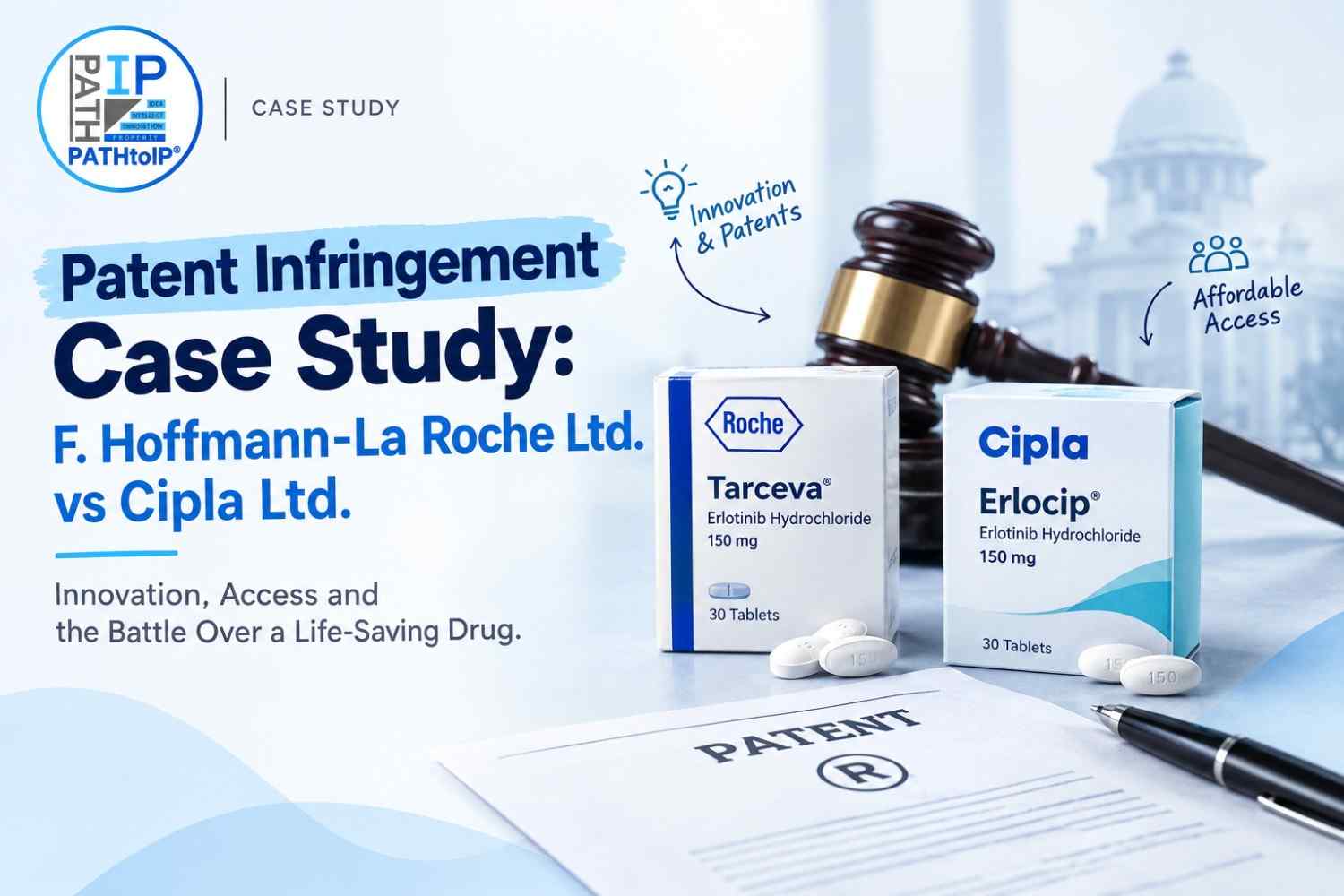
This case happens to be among the first significant pharmaceutical patent infringement disputes in India, and it raised crucial questions regarding the innovator’s patent rights and the availability of life-saving drugs to the local population.
- Hoffmann-La Roche Ltd. is a multinational healthcare corporation with its primary headquarters in Switzerland and a wide range of operations in the pharmaceutical and diagnostic industry. The company owns an Indian patent for Erlotinib Hydrochloride, an Epidermal Growth Factor Receptor (EGFR) inhibitor used for treating lung cancer, which it markets in the Indian territory under the Trademark Tarceva.
Cipla Ltd. (Defendant)
The situation presents a case of the possibility of challenging the innovator’s patent and a claim for non-infringement on grounds of validity of the patent. It is seen that public health issues are being taken into account for ruling decisions.
Cipla Ltd. is one of the largest Indian multinational pharmaceuticals and biotechnology companies which specializes in the production of generic copies of patented drugs. The case relates to one such product, Erlotinib Hydrochloride sold under the trademark Erlocip at a much lower price than the innovator’s Tarceva produced by Roche.
Case Overview
- Case Title: F. Hoffmann-La Roche Ltd. & Anr. vs Cipla Ltd.
- Court: Delhi High Court (Single Judge, 2012; Division Bench, 2015); Supreme Court of India (SLP, 2016–2017)
- Issue: Patent infringement of Erlotinib Hydrochloride (Indian Patent IN 196774 / IN ‘774) marketed as Tarceva, by Cipla’s generic Erlocip
Background
- Roche was granted Indian Patent IN 196774 for Erlotinib Hydrochloride. In 2006 Roche launched Tarceva in India. The price of each tablet was around Rs. 4,800.
- In December 2007 and January 2008 reports came out that Cipla was planning to launch a version of the drug. The name of the medicine was Erlocip. It was set to cost about Rs. 1,600 Per tablet. This price was one-third of the price charged by Roche for the same medicine.
- Roche filed a lawsuit in the Delhi High Court in January 2008. Roche asked for an injunction to stop Cipla from launching its product.
- Cipla said two things in their defense. First, they said their product used Polymorph B of Erlotinib Hydrochloride. This was a form, then what Roches patent covered. Second, they talked about their interests. They said stopping a version of a life-saving cancer drug would make it harder for patients to get the treatment they needed.
- Polymorph B was at the center of a patent fight in India. Roche tried to get a patent for Polymorph B, but the patent office turned it down. Cipla used this rejection to claim that Polymorph B was an invention that had no patent, in India.
Court’s Decision
- Single Judge (2008–2012): The Delhi High Court declined to grant Roche an interim injunction, holding that public interest favored continued availability of the lower-priced generic for a life-saving drug. In September 2012, the single judge ruled that Cipla’s Erlocip (Polymorph B) was scientifically distinct from Roche’s patented compound and did not infringe.
- Division Bench (2015): On appeal the Division Bench changed its decision about infringement. It said that Ciplas’ product Erlocip did break Roches patent IN ‘774. The bench explained that Section 3(d) of the Patents Act, 1970 which stops patents for forms of old medicines if they don’t work better cannot be used as a reason to avoid an infringement case. It also created a way to check if there is infringement when it comes to different forms of the same medicine.
- Supreme Court (2016–2017): Cipla submitted a Special Leave Petition asking for the appointment of an expert to look at the scientific results; the Supreme Court accepted the appeal in early 2016. Before the final decision was made the two sides agreed on a settlement, on 30 May 2017. Cipla took back its SLP in June 2017 ending the legal fight that lasted almost ten years.
Significance
- One of the patent infringement cases in India took place after the country changed its rules in 2005 to a product-patent system for pharmaceuticals. This shift was a turning point. Led to a landmark case, in the field of patent law especially in the pharmaceutical industry.
- Clarified that Section 3(d) works as a reason for a patent to be valid or granted. Section 3(d) does not serve as a defense, against infringement.
- Established a claim-based approach for assessing infringement in cases involving polymorphic forms of a patented compound.
- Set an influential precedent for how Indian courts weigh public interest and access to affordable medicine against interim injunctive relief in pharmaceutical patent disputes.
Key Takeaways
This case remains a foundational reference for India’s pharmaceutical and patent litigation landscape.
- Balances Innovation and Access: The ruling illustrates how Indian courts weigh patent enforcement against public health needs, particularly for life-saving drugs.
- Polymorph Claims Require Precision: Patentees must clearly define the scope of claimed compounds, including polymorphic forms, to avoid ambiguity that generic competitors can exploit.
- Section 3(d) Has Limited Defensive Use: Section 3(d) governs patentability at the grant stage; it cannot be repurposed as a defense once infringement is alleged.
- Litigation Timelines Matter: The dispute spanned nearly a decade across multiple judicial forums, underscoring the importance of strategic patent drafting and early freedom-to-operate analysis to avoid prolonged litigation.
Conclusion
The Roche vs Cipla litigation stands as a landmark in Indian pharmaceutical patent jurisprudence. It tested the interplay between patent exclusivity and public health access in one of the earliest disputes under India’s post-2005 product patent regime, and its interpretation of Section 3(d) and polymorph-based infringement continues to guide pharmaceutical patent strategy and litigation in India today. The case underscores the importance of precise patent claim drafting and thorough prior art and freedom-to-operate analysis for both innovators and generic manufacturers.
Hoffmann-La Roche Ltd. vs Cipla Ltd.
References:
Related Reads:
Case Study: Cipla Limited V/S Sun Pharmaceutical Industries Ltd
If you have any queries related to Patentability Search or Freedom to Operate analysis, please feel free to connect. At PATHtoIP LLP we ensure that every client receives exceptional results & insights through high-quality Intellectual Property research. As an experienced firm, Roche vs Cipla Patent we are dedicated to providing IP protection & delivering results capable of reaching your goals.
Stay connected with PATHtoIP for the latest insights on patents, trademarks, copyrights, innovation, and IP strategy. Follow us on LinkedIn, Instagram, Facebook, X , Pinterest, YouTube, and Quora for expert guidance, industry updates, case studies, and practical tips to protect your innovations.
Frequently Asked Questions
What was the Roche vs Cipla case about?
Roche sued Cipla in the Delhi High Court in 2008 for patent infringement, alleging that Cipla’s generic drug Erlocip infringed Roche’s Indian patent (IN 196774) for Erlotinib Hydrochloride, sold by Roche as Tarceva for lung cancer treatment.
Why did Cipla claim it wasn’t infringing Roche’s patent?
Cipla argued that its product, Erlocip, was based on Polymorph B of Erlotinib Hydrochloride, a form distinct from what Roche’s patent claimed. Cipla pointed out that Roche had separately tried and failed to patent Polymorph B in India, suggesting it was a different, unpatented invention.
How did courts balance patent rights against access to medicine in this case?
The single judge refused Roche an interim injunction, holding that public interest favored keeping the lower-priced generic available for patients needing a life-saving cancer drug, even while the infringement question remained unresolved.
What did the Delhi High Court’s Division Bench decide on appeal?
In 2015, the Division Bench reversed the single judge’s non-infringement finding and ruled that Cipla’s Erlocip did infringe Roche’s patent. It also held that Section 3(d) of the Patents Act cannot be used as a standalone defense to an infringement claim.
How did the Roche vs Cipla dispute finally end?
After Cipla’s appeal to the Supreme Court and its request for a technical expert review, the parties reached a settlement on 30 May 2017, and Cipla withdrew its Special Leave Petition in June 2017, closing out nearly a decade of litigation without a final Supreme Court ruling on the merits.