What Is the Information Disclosure Statement?
Definition
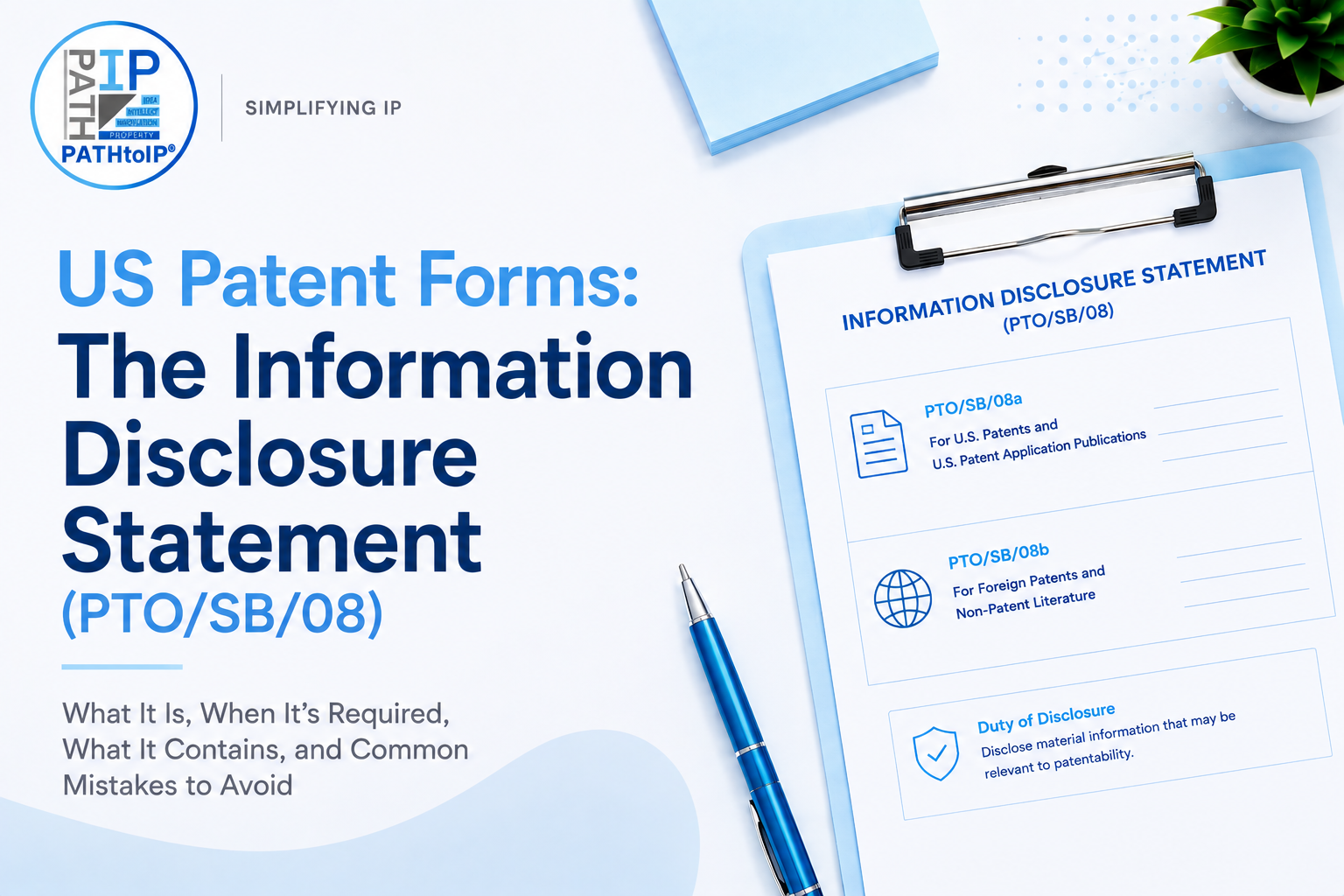
The Disclosure of Information Statement (IDS) Form PTO/SB/08 (submitted as PTO/SB/08a for patent documents and PTO/SB/08b for -patent literature) is the form used to present known prior art and other relevant information to the United States Patent and Trademark Office (USPTO) while a patent is being processed. It is similar to India’s Form 3 in the United States.
Why It’s Effectively Compulsory
Filing an Information Disclosure Statement is something you have to do when you have information to share.. The reason you have to do it is not something you can choose to do or not do. According to the rules every person who helps with a US patent application has to keep telling the truth about what they know. This means they have to share any information that might affect whether the patent is valid. The Information Disclosure Statement is how they do this. In life almost every patent application ends up filing an Information Disclosure Statement. This is because it is very rare for the person who invented something or their lawyer to not know about similar things that already exist. If you know about something that’s similar and you do not tell anyone it can cause big problems later on. It is not an idea to skip this step just to save time on paperwork. If you do, the patent you get might not be valid. The Information Disclosure Statement is a part of the process when you are applying for a US patent.
The Two-Part Structure
The Information Disclosure Statement is not a sheet it is split into two parts depending on what is being disclosed. The Information Disclosure Statement has two forms PTO/SB/08a is used for listing United States patents and United States patent application publications. On the other hand PTO/SB/08b is used for listing foreign patents and other things like journal articles, technical papers or other publications.
Most of the time people file both the Information Disclosure Statement forms because it is rare for the relevant prior art to be only from the United States or only, from non-patent things.
Foreign-Language Prior Art
When you have a reference that’s not in English like a patent from another country or a journal article you need to give a translation in English along with the original. Sometimes you can just give an explanation of why it is important instead of translating the whole thing but this is only okay in certain situations. So it is usually better to give the translation. If you do not give a translation the person looking at your application may not be able to understand the reference. That is a problem. The reference is, like a patent or a journal article so you need to give a translation of the reference.
What the IDS Contains
Header Information
- Application number and filing date
- First-named inventor
- Art unit and examiner name (if known)
- Attorney docket number
US Patent Documents
A list of relevant US patents and published applications, with document number, publication date, and the patentee or applicant name.
Foreign Patent Documents
Relevant patent documents from other countries, including the country code, publication date, and an English translation where the original is not in English.
Non-Patent Literature
Articles, technical papers, or other publications that may be material to patentability filed on the companion PTO/SB/08b sheet, with an English translation attached if the original is in another language.
Certification or Fee
A statement confirming the IDS complies with the timing requirements of 37 C.F.R. § 1.97, or the fee required if that certification can’t be made.
Example of an IDS Filing
Consider a nonprovisional application filed for a new type of water filtration cartridge. During prosecution, the attorney handling the case discovers a similar cartridge design was covered in an earlier US patent, and a related filtration method was described in a foreign patent application filed in Germany two years earlier. Both need to go on the IDS: the US patent listed on the PTO/SB/08a sheet with its patent number and issue date, and the German application listed on the PTO/SB/08b sheet with its publication number, date, and an English translation attached since the original document is in German. Once filed within the required timing window, the examiner reviews both references alongside the application’s claims.
Common Mistakes and How to Avoid Them
Missing Copies of Cited Documents
When you are dealing with references and things that are not patent literature you need to send them in with the IDS. You cannot just make a list of them. A lot of the time people get their IDS rejected because they did not do this right.
To avoid this problem you should do the following:
Attach the version of every foreign reference and every non-patent reference when you first send in the IDS do not wait until later.
Submitting Foreign-Language Documents Without Translation
A reference filed in its original language, without an English translation, often can’t be properly considered by the examiner and may simply sit in the file unreviewed. Avoid it by: preparing and attaching an English translation for every non-English reference before filing.
Filing Late Without the Right Certification or Fee
An IDS filed after certain points in prosecution (such as after a first Office Action) requires either a certification under 37 C.F.R. § 1.97 or a fee. Missing this step means the examiner may simply place the IDS in the file without considering it. Avoid it by: tracking the prosecution stage before filing and confirming whether a certification or fee applies.
Not Resubmitting After a Non-Compliant Filing
If an IDS is filed incorrectly, it isn’t automatically corrected by the USPTO, it simply won’t be considered, and the gap often isn’t noticed until much later in prosecution. Avoid it by: confirming the IDS was accepted and considered, not just filed, before treating the disclosure duty as satisfied.
Under-Disclosing What Counts as “Material”
It’s a common assumption that only patents count, leaving out related non-patent literature, prior related applications, or foreign counterpart office actions. Avoid it by: treating anything that questions the novelty or obviousness of the invention as fair game for disclosure, including related filings from the same applicant.
IDS vs. India’s Form 3: A Quick Comparison
| US Information Disclosure Statement (PTO/SB/08) | India Form 3 | |
| Governing provision | 37 C.F.R. §§ 1.56, 1.97, 1.98 | Section 8, Patents Act 1970 & Rule 12, Patents Rules 2003 |
| Mandatory? | Required only when material information is known; the underlying duty of disclosure is continuous | Mandatory for every application with corresponding foreign filings |
| Structure | Two-part sheet, PTO/SB/08a for patents, PTO/SB/08b for foreign patents and non-patent literature | Single statement-and-undertaking form |
| What’s disclosed | Known prior art, patents, publications, and other material information affecting patentability | Details of corresponding applications filed in other countries for the same or substantially the same invention |
| Timing | Filed anytime during prosecution; certification or fee needed after certain stages | Filed with the application or within six months, then updated within three months of the First Examination Report |
| Ongoing obligation | Duty of disclosure continues until the patent issues | Undertaking to keep the Controller informed continues until grant |
Where to Find It
Official Source
USPTO Information Disclosure Statement forms (PTO/SB/08a and PTO/SB/08b): https://www.uspto.gov/patents/apply/forms
Related Reading
- PTO/AIA/14 (US): Application Data Sheet, previous in this series
FAQs
Is an IDS required even when there’s no known prior art?
No. If there’s genuinely nothing material to disclose, there’s nothing to file. The obligation is to disclose what is known, not to go searching for art that doesn’t exist.
What happens if a known piece of prior art is left off the IDS?
It can be treated as a failure to meet the duty of candor, which in serious cases can make the resulting patent unenforceable, even after it’s been granted.
Can an IDS be filed after the application has already been examined?
Yes, but later filings typically require either a certification confirming compliance with timing rules or payment of a fee, so it isn’t as simple as filing whenever convenient.
Stay connected with PATHtoIP for the latest insights on patents, trademarks, copyrights, innovation, and IP strategy. Follow us on LinkedIn, Instagram, Facebook, X , Pinterest, YouTube, and Quora for expert guidance, industry updates, case studies, and practical tips to protect your innovations.