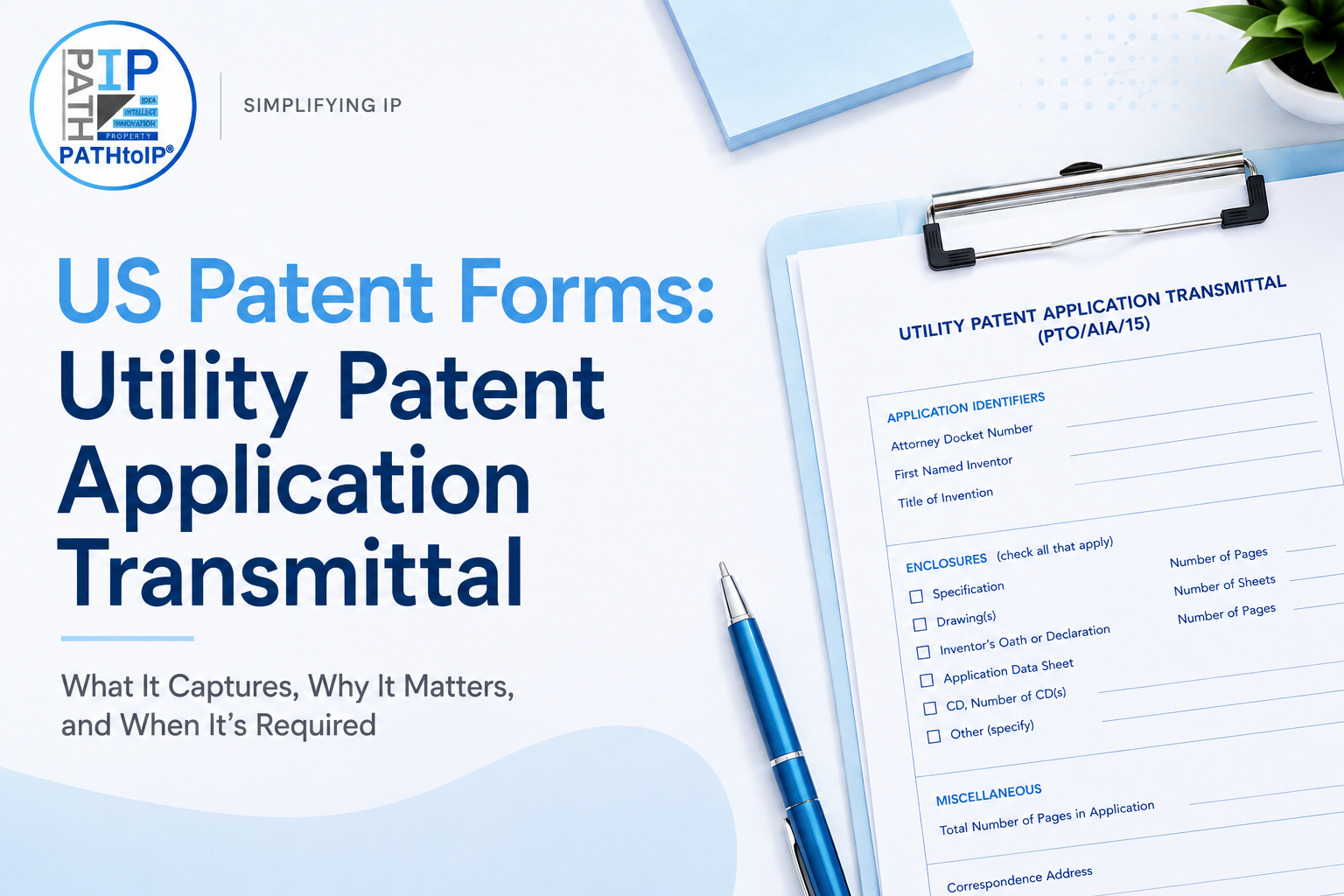
What is the Utility Patent Application Transmittal?
The Utility Patent Application Transmittal is a form that people use when they file a Utility Patent Application with the United States Patent and Trademark Office. This form is also called the Form PTO/AIA/15.
The Utility Patent Application Transmittal is used when someone files a Utility Patent Application. It is not used for kinds of applications like provisional applications or design applications.
Each of these has its form that it uses. The Utility Patent Application Transmittal is like a form that they use in India. It is similar to Form 1 that they (add who uses this form) use in India because it says what is in the application.
The Utility Patent Application Transmittal is the form that we are looking at to see how it is different from the forms used in India.
What the Utility Patent Application Transmittal captures
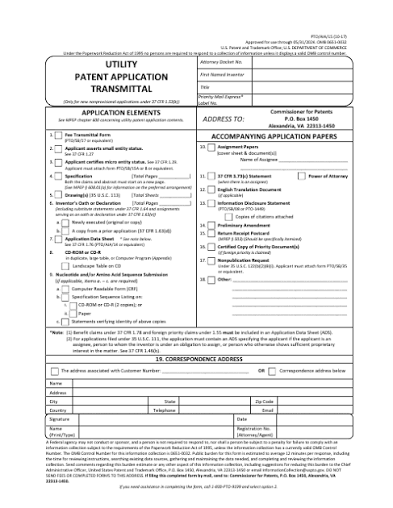
The Utility Patent Application Transmittal is like a list that has all the details. It shows the USPTO what is in the package that is being sent to them. The Utility Patent Application Transmittal captures things like the attorney docket number. It also has the name of the person who invented something, which is the first named inventor. The Utility Patent Application Transmittal has the title of the invention too.
The Utility Patent Application Transmittal is a checklist that includes every document that is being sent with the application. These documents are the specification and the drawings. The Utility Patent Application Transmittal also includes the inventor’s oath or declaration. The Application Data Sheet is part of the Utility Patent Application Transmittal.
There are papers that can be sent with the Utility Patent Application Transmittal like assignment documents or an Information Disclosure Statement. The Utility Patent Application Transmittal even captures the address where the USPTO will send letters about the application, which’s the correspondence address, for the application. The Utility Patent Application Transmittal is very important because it helps the USPTO keep track of the Utility Patent Application.
Why does the Utility Patent Application Transmittal matter as a record?
The Utility Patent Application Transmittal is not the place where you get your rights. It does not create priority claims by itself. It does not name the inventors by itself. The Utility Patent Application Transmittal has a role. It is proof of what was filed and when it was filed, which helps the applicant if someone questions the filing or if something gets lost.
The Utility Patent Application Transmittal lists the number of pages and sheets for the specification, drawings and oath or declaration. This gives the USPTO and the applicant a record to check against. If there is a problem later the Utility Patent Application Transmittal is what you look at to figure it out.
The Utility Patent Application Transmittal also has a note about what it covers. If you want to make benefit claims under 37 CFR 1.78 or foreign priority claims under 37 CFR 1.55 you still have to do that in an Application Data Sheet not in the Utility Patent Application Transmittal.
The Utility Patent Application Transmittal just says that an Application Data Sheet was included. Similarly, if the applicant is someone who is supposed to get the rights from the inventor or someone who has a reason to own the invention under 37 CFR 1.46(b) that applicant still has to be named in an Application Data Sheet, for certain types of applications like those filed under 35 U.S.C. 111. The Utility Patent Application Transmittal does not do that.
When Is the Transmittal Required?
When you send in an application the United States Patent and Trademark Office look at the date, they get the specification and the drawings. They do not care about the transmittal it is, like the ADS it does not matter for this.
The United States Patent and Trademark Office say you should always send a Utility Patent Application Transmittal Form with your utility application. You can also use a transmittal letter that does the thing. This is the way to tell the United States Patent and Trademark Office what you are sending them.
What Happens Without One?
If a transmittal is not filed, the application can still be processed. This is because the filing date depends on the specification and drawings not on the transmittal. Without a transmittal the Office and the applicant lose a clear record of what was submitted. It is harder to confirm that a document, such as the ADS or the oath or declaration was part of the original filing package.
A transmittal letter can be used instead. However, it needs to cover the information, as the transmittal. The transmittal letter and the transmittal serve the purpose.
The applicant and the Office rely on the transmittal to keep track of the application. The transmittal helps to confirm that all required documents are included.
The specification and drawings determine the filing date. The transmittal is not required for processing. However, it is helpful to have a transmittal. It provides a record of what was submitted.
What the Transmittal Contains?
- The Utility Patent Application Transmittal is made up of a list of things that need to be included with the Utility Patent Application and then there is a list of other papers that need to be sent with it.
- Application identifiers include things like the attorney docket number, the named inventor and the title of the invention.
- Entity status has boxes to check if the Utility Patent Application is for an entity under 37 CFR 1.27 or if it is for a micro entity under 37 CFR 1.29. If it is for an entity the micro entity certification form needs to be attached.
- The Fee Transmittal Form is mentioned, which is the PTO/SB/17 form or something similar.
- The Specification part lists the number of pages. It is important to note that the claims and the abstract must each start on a page.
- For the Drawings part the total number of sheets of drawings is listed, which are filed under 35 U.S.C. 113.
- The Inventors Oath or Declaration part lists the number of pages and whether it is a new one or a copy from a prior Utility Patent Application under 37 CFR 1.63(d). This also includes substitute statements under 37 CFR 1.64 and assignments that work as an oath or declaration under 37 CFR 1.63(e).
- The Application Data Sheet part confirms that an Application Data Sheet under 37 CFR 1.76 is included, which can be the Form PTO/AIA/14 or something similar. There is also a note about the benefit and priority claims mentioned earlier.
- A CD-ROM or CD-R is used for tables, landscape tables or a computer program listing that is filed as an appendix.
- For the Nucleotide and/or Amino Acid Sequence Submission if it applies it includes the Computer Readable Form, the sequence listing itself and statements that verify the copies match the Utility Patent Application.
Accompanying application papers
The transmittal form has a list of papers that people can send with their application. These papers include things like assignment papers and the name of the person the application is being assigned to. It also includes a statement or a power of attorney if someone else is taking care of the application. If some of the papers are not in English people need to send a translation. They also need to send a statement that says what they know about the application.
People can also send an amendment, which is like a first draft of changes they want to make. They can ask for a postcard to be sent back to them to prove that their application was received. If they are sending papers from another country they need to send a certified copy. They can also ask for their application to be kept private, and they need to fill out a form to do this. There is a line on the form for anything else that does not fit into these categories.
At the end of the transmittal form people need to write down their address, which’s where they want to get mail, about the application. They can use a customer number or write down their full address. The person who is sending in the application also needs to sign it and write down their name and registration number. They need to include their phone number and email address so people can get in touch with them. Finally, they need to write down the date that they are sending in the application.
Updating the Transmittal
The transmittal is different from the Application Data Sheet. It does not get changed after it is filed. The transmittal is like a picture of what was sent with the application on the day it was filed. If something that was supposed to be sent with the application is missing the application will still be okay. To fix the problem you need to send the missing thing to them. You have to follow the rules, for that missing thing. You do not need to send a transmittal or change the old one. You just send the missing item like the transmittal is a record of what happened on that day and that is it.
Utility Patent Application Transmittal vs. India’s Form 1: A Quick Comparison
| US Utility Patent Application Transmittal (PTO/AIA/15) | India Form 1 | |
| Governing provision | 37 CFR 1.53(b); MPEP Chapter 600 | Patents Act, 1970 & Patent Rules, 2003 |
| Mandatory? | Recommended with every nonprovisional filing; a transmittal letter can serve the same purpose | Mandatory with every application |
| Structure | Itemized checklist of enclosures and application elements | Declaration-style application form |
| What it establishes | Nothing substantive on its own; records what was filed | Declares applicant, inventor, and application particulars |
| Amenability | Not corrected after filing; missing items are filed separately under their own rule | Governed by separate procedural rules for amendment |
Where to Find It
The official source is the USPTO Utility Patent Application Transmittal, also known as Form PTO/AIA/15. You can find this at https://www.uspto.gov/patents/apply/forms.
Related Reading
The Application Data Sheet (Form PTO/AIA/14), which the transmittal checklist points to directly, was covered first in this series.
FAQs
Is the Utility Patent Application Transmittal the same as Form 1 in India?
Not exactly. The Utility Patent Application Transmittal is a checklist confirming what was filed with a US application. Form 1 in India is a declaration-style form that itself states applicant, inventor, and application details, so the comparison is only partial.
Does filing the Transmittal affect my filing date?
No. Under 37 CFR 1.53, the filing date for a nonprovisional application depends on the specification, and any required drawings, being received. The transmittal is not part of that test.
Can I fix a mistake on my Transmittal after filing?
The transmittal itself is not typically refiled or corrected. If an item listed on it, such as the ADS or the oath or declaration, was actually missing or incorrect, the fix is to file the correct version of that item under its own governing rule, rather than to amend the transmittal.
Stay connected with PATHtoIP for the latest insights on patents, trademarks, copyrights, innovation, and IP strategy. Follow us on LinkedIn, Instagram, Facebook, X , Pinterest, YouTube, and Quora for expert guidance, industry updates, case studies, and practical tips to protect your innovations.